Alhambra
Overview:
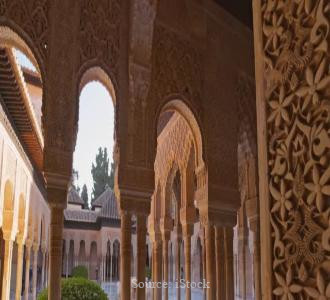
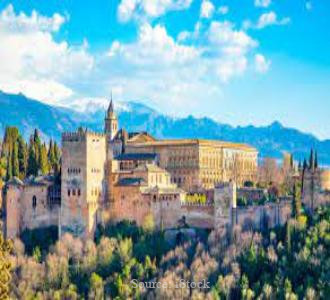
The Jewel of Granada, the great Red city of the Alhambra is a stunning Moorish complex that is both a fortress, a palace, a garden and was once a great citadel that perches above the stunning Spanish city of Granada, with the incredible Islamic Architecture, stunning green gardens, towering halls and lavish courts and halls which all sit within its stunning grounds making the Alhambra an absolutely stunning example of Moorish Architecture and civilisation and a true wonder of the world.
Believed to have been constructed between the 13th and 14th centuries by the Moorish emir Ibn Al-Ahmar, the site of the Alhambra – perched above the city of Granada is itself steeped in history with it known to have been a key vantage point during the Roman Empire – and which now offers stunning sunrise views over the incredible city of Granada below it, with it also having once been a fully functional fortified city at its peak in the years following its establishment, and holding a special place in Moorish history as a place of culture, art and life.
Once known as the red city – reportedly after the beard of the Emir and the unique red sandstone used to construct it — the Alhambra is also an important historical monument with its magnificent interior and structure standing as a lasting monument to the beauty of Moorish Architecture – which are all easily explorable today, with the renaissance style Palace of Charles V, the stunning remains of the Alcazaba fortress, the eloquent palaces of the Nazaries and the lush green gardens and insight into daily life within this wonder afforded within the Generalife – which combined with the stunning sunset views of the wonder from the main squares of Grenada making the Alhambra not just a feat of incredible Moorish architecture, but a standing and intriguing beautiful historical fortress and a unique and storied wonder of the world.
Where:
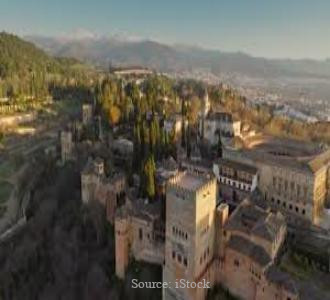
The beautiful Alhambra fortress sits a top a hill in the south of Spain in the city of Granada – with the stunning Sierra Nevada mountains flanking it on one side, the beautiful Spanish countryside visible on the other – and there being stunning views of the serene Spanish town of Granada in full view below it.
Getting there:
Found in the foothills of the stunning Sierra Nevada mountains, Granada is a small but stunning town in the south of Spain and you’ll need to get to the town first before heading up the hill to see the wonder of Alhambra.
To get to Granada you have a couple of options, the most direct is to fly to the Airport of Granada – which is found half an hour outside the city, but which is small and for whom you can expect to pay almost €200 one way from most major European Cities.
Although we’d advise flying into either Malaga or heading to Granada on a tour of Spain (including taking in the wonder of the Sagrada Familia) and getting a train or bus into Granada – with Spain’s excellent train network that runs almost hourly letting you go direct to Granada in an hour – at a cost of approximately €10 from Malaga giving you a cheaper and much more enjoyable experience into Granada.
Once in Granada from the city centre you can get Bus C3 from the city centre that takes you direct to the Alhambra for €2.50 or simply hop in a taxi that will take you up the hill. For those who have the stamina and fancy the trek heading up the hill in the Spanish Sun – our advice is to head to the square of Plaza Nueva and then simply follow the road up Cuesta de Gomerez that will take you up to the base of the wonder – testing your endurance in the process.
From the base of the wonder you have your pick of entering via the pavilion main entrance on the east side of the wonder – where the main ticket office is – or for those with pre-purchased tickets head to the Gate of Justice where you can skip the line with your e‑ricket and head straight into the incredible wonder.
Best time to Visit:
Given Granada can get uncomfortably hot in the summer – and see snow in the winter – we’d recommend visiting in either spring of Autumn, when crowds won’t be at their peak and the weather will be agreeable – with the months of either April or May or September or October being out picks for the time of year to visit.
For the time of day, you’ll be at the mercy of when you can book a slot as only 300 people are allowed into the ground every half hour, but if you can book in advance wed advise aiming for an early sunrise spot, where you can catch the beauty of Granada lighting up with the sunrise below you before heading to the main Granada square of Mirador San Nicolas at sunset for some incredible views of the sun setting over the incredible wonder of the Alhambra.

Explore:
The pinnacle of Moorish Architecture the medieval Alhambra complex is four unique sights rolled into one with the Fortress known as the Alcazaba, the stunning palaces known as the Palacios Nazaries, the government area known as the Medina and the lush gardens — the Generalife all combining to make this former home of the sultans a vast imposing and stunning wonder.
As well as being a scenic wonder, the Alhambra is caped in history, with the walls of the palaces themselves still retaining the written carved etchings that tell the history of the complex, as well as being home to a series of woven visual representations of the beliefs and gods that influenced the Moorish people who called this grand complex home many centuries ago.
A vast and stunning wonder, the below are our top sights to see in the incredible Alhambra:
Alcazaba
Beginning with the fortress area that has stood since the 13th century, the imposing walls of the Alhambra complex, known as the Alcazaba, stand atop a hill overlooking Granada and are perhaps the most iconic element of the whole of the complex.
The first part of the complex to be explored upon arrival, you’ll notice not only the stunning view of Granada below you, but also a series of stunning designs on the walls themselves from the previous Moorish population, and you can get a flavour of both the fortress and security that these walls afforded when the great city was active, before you journey inside the walls, to begin exploring the great wonders of the Alhambra.
The Palacios Nazaries
The beauty of the complex, the Palacios Nazaries contains a series of palaces, our favourite of which is the great Nasrid royal palace – a towering and stunning palace that really does represent the pinnacle of Moorish architecture, with stunning floors, carved ceiling and incredibly well preserved ceilings and archways carved out of wood and stunning tiled floors – a true architectural wonder!
We’d advise coming here first, as the palace does get a bit crowded, with the start of the palace leading you first into the Mexar, the oldest but most renovated section of the palace which was used as a public admin room and for large gatherings and feasts. For the observant you’ll notice this area also has hallmarks of being used as a chapel from when the Christians conquered Spain.
As you journey through the incredible palace you’ll also come to the Cuarto Dorado – a golden chamber, with further stunning tiling and ceiling work before you journey into a small prayer room and then into a series of ruins which marks the last standing parts of the Palacios Nazaries, before they were annoyingly destroyed by Yusuf I in the 14th century.
Palace of Charles V
Alongside the Palacios Nazaries, you’ll find the great Alhambra complex home to further incredible palaces, with perhaps the most stiking being the Palace of Charles V, a somewhat newer addition to the Alhambra from the 15th century and constructed, although never finished, after the Christian conquest of Granada.
A towering palace, and somewhat out of place next to the Moorish architecture, the palace was designed to be grander and bigger than the rest of the complex and comprises two levels that reach 17 metres high and features an impressive inner courtyard, towering columns and stands as one of the best pieces of renaissance era architecture in the whole of Spain.
But the real joy of the palace is the two museums that sit within it – one on each floor, with the Museo de la Alhambra on the lower floor telling the history and tales of the Alhambra and containing recovered historical pieces and art from throughout the life of the Alhambra and the second floor Museo de Bellas Artes de Granada (Fine Arts Museum) – which features some stunning renaissance era to modern paintings of the sights of Granada and of the Alhambra – for a great place to immerse yourself in the incredible history of this wonder of the world.
Myrtles Courtyard
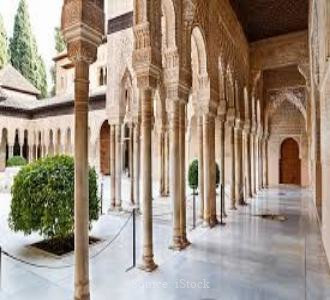
Exiting the Palace we’d advise next heading for the court of the Myrtles on a route that takes you to the main spots of the Alhambra complex before others arrive. At this courtyard you’ll note a large, long pool with hedges and the Arab palace in front of you – giving you that incredible iconic photograph from inside the Alhambra.
If you’re lucky you’ll be able to get a clear photo and you’ll see the reflection of the white marble patio reflected in your shot, with the two fountains that feed into the pond only adding to the immense beauty of the courtyard – with this courtyard once standing as a proud symbol of the power and strength of the Moorish and the beauty of the Alhambra complex.
Court of Lions
Moving through the Myrtles courtyard, you’ll pass the Arab palace and come into the palace of the lions a once winter retreat for the Emir and the occupants of the Alhambra – who struggled to deal with the shifting climates in Spain.
Through the palace you’ll come into an open courtyard – the stunning Court of the Lions – with 124 incredible white marble columns that act as both an art installation and as a way to reflect the light into the centre of the courtyard – while you’re find the stunning Lion Fountain, one of the icons of the Alhambra.
The Lion Fountain, carved out of Stone, has 12 smaller lions at its base – each representing Moorish Beliefs and stands as a symbol of power, belief and unity, with the Lion believed to have spouted water out of its mouth on regular intervals every hour to mark the passing of time, at its base you’ll find a series of carved dedications to the Lion dating back to the 15th century – it’s really worth spending some time here to take in the incredible towering Lion Statue before moving on to explore the great halls of the Alhambra.

Sala de los Abencerrajes
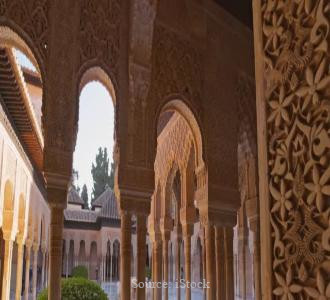
From the court of the Lions you can head south continuing your tour round the Alhambra and enter into the hall of the Abencerrajes – named after the legends of the Abencerrajes Knights who were believed to be warriors blessed by God and who according to legend met their end within this hall – being beheaded.
While stories about the Abencerrajes knights differ, what is established is to great beauty of this hall, with the great domes within it towering and illuminating the fountain that sits within this square hall and the multi-coloured ceiling above it – with the ghosts of the Abencerrajes Knights said to revisit this hall on the anniversary of their death !
Hall of the Two Sisters – Leaving the Abencerrajes Hall, you’ll come into the Hall of the two sisters – named after two marble slabs rather than anything sinister – with the slabs clocking in at 15 foot high and sitting in the middle of another domed room with a stunning tiled fresco and of course a further fountain in the middle of the hall – for another truly stunning hall.
Hall of the Kings – Moving on from the two sisters and back into the Lion Courtyard, you’ll find another hall – this one worthy of the kings – being a great rising hall featuring a series of seven domes that soar into the clear Spanish sky.
Known as the Sala de los Reyes, the most stunning element of the hall is the painted frescos on the ceiling that date back to the 15th century and show the daily life within the Alhambra, an incredible beautiful and scenic hall where you can snap some stunning photos and get a unique life into the daily Moorish life of a King.
Hall of the Ambassadors — Continuing through the great Alhambra complex and you’ll come to the grandest hall of them all – the hall of the ambassadors that also served as a throne room and is the largest room in the whole of the Alhambra complex.
Entering through a carved archway you’ll approach the great throne that lies at the head of the hall, passing multiple religious chapters and floral decorations carved into the floor of the hall as you re-trace the steps that ambassadors once trod to approach the great ruler of Granada.
Of particular interest are the great nine stain glass windows that illuminate the hall and the multi-coloured ceiling and create an imposing pathway to the king, with the ceilings themselves being particularly beautiful and decorated in the shape of stars, moon and crowns that reflect the wisdom of the Nasrid Kings that once sat in this great hall.
This Hall is also the spot of unique history, being the place of ritual executions and with it leading to the great Comares Tower where the Moorish are believed to have made their last stand against the Catholic invasion.
Comares Tower – As you exit the great hall of the ambassador you’ll notice a series of towers on either side – though some are but ruins the biggest still standing is the impressive Comares Tower with incredible stained glass windows that look down into the Kings hall and which – through a steep staircase – you can summit for incredible views down into the grand hall below you and for stunning views of the Sierra Nevada Mountains through its windows.
Alongside offering stunning views and being a great example of the security of the complex, the Comares Tower is also again steeped in history – with it reportedly being the place of the last stand of the Moorish before the rule of Alhambra fell into the hands of the Catholics in the 15th century – with the final Nasrid King taking time to observe his hall from this tower before finally surrendering.
Generalife
The gardens of the king, the Generalife is accessed be exiting the hall of the ambassadors and crossing a quaint bridge into the great green gardens of the Nasrid where you’ll find a series of stunning gardens, lush green flora and some incredible water displays and fountains that give you a great place to sit and admire both the stunning architecture of the Alhambra, the rolling Sierra Nevada Mountains and the beauty of Granada below you.
Journeying into the gardens, you’ll find them in an almost Italian style and separated into Lower Gardens with a series of square ponds that leads to the great Generalife Palace where you can grab spectacular views of the whole of the Alhambra before you. For those with a keen sense of horticulture you’ll like to spend time admiring the main canal that criss-crosses the gardens as well as the water stairway – two stunning aquatic features that really light up the lush green Flora found in this exquisite garden.
Once the favourite spot of the Moorish Kings int eh 14th century, the Generalife extends up the great hill in Granada and follows a simple circular path, allowing you to see all the highlights of this incredibly stately garden with there also being serene, wooded areas, sparkling flowerbeds, a Cypress avenue and a chance to sit under the hill of the Emirs in the shade and ponder on the beauty of the Alhambra – as so many Kings and Emirs have done before you.
Breath-taking Views:
Alongside exploring the incredible Alhambra up close, part of its beauty undoubtedly comes from the stunning views it offers of Granada below – with the great fortress having been purposely built on a hill to offer protection through the Alcazaba walls, also giving you the best views of the snow-capped peaks of Sierra Nevada and the sparkling city of Granada – with these views alone making a trip up the Alhambra worth it.
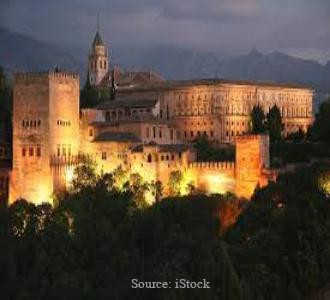
Further as the Alhambra sits a top a hill, it also offers stunning views from the ground, with it being positioned to watch the glorious Spanish sunset illuminate this incredible monument a top the hill – with a sunset viewing of the whole of the Alhambra fortress from a Spanish café down below being a perfect way to cap off a visit to this incredible wonder of the world.


How long to stay:
We’d recommend budgeting a half day for the Alhambra, you’ll only need 2–3 hours to summit the hill and explore the great complex – which is best done early in the morning – but if you can time your visit to Granada with a trip to the Mirador San Nicolas square in the evening to watch the sunset over the fortress you’ll get stunning view of this incredible wonder.
Top Tip:
With the Alhambra being a stunning wonder it’s incredibly popular – which is not helped at times by the visitor limits put in place which can cause long queues outside, which in the Spanish sun cannot always be fun, so we’d advise to be sure to visit in the off season in Spring or Autumn and be sure to get your tickets in advance for an early morning slot and then top your tour off with a sunset viewing from the squares of Granada.
Alongside that Spain is overall a very safe country, so be sure to come with plenty of water and sunscreen to protect yourself against the Spanish sun and give you an overall more enjoyable experience at the wonder of the Alhambra.
Cost:
Tickets to the Alhambra are incredibly popular and sell out fast even in the off season – mainly as a result of there being visitor limits to enter the grounds of the Alhambra of 300 every hour – so it’s advise to pre-book well in advance at [https://tickets.alhambra-patronato.es/en/] and grab an early morning timeslot for the best views of Granada below and for a more enjoyable experience.
Once online you can expect tickets to cost €14.85 – and it’s advised to get there 15 minutes before your time slot starts to avoid potentially large queues.
All in all, accounting for a bus or trip to the Alhambra from Granada and a bite to eat, you can expect to pay €30 euros to visit this spectacular wonder – which in our book is a bargain.
Best photo spot:
While the inside of the Alhambra offers many incredible photo spots, not least the iconic photos of Myrtles Courtyard and the beauty of the hall of ambassadors from the Comares Tower – the spot where the last king of the Moorish came to view the beauty of the Alhambra before surrendering – our top pick for a photo of the Alhambra is the famous sunset photo of the whole of the complex and the outer Alcazaba walls from the streets of the Mirador San Nicolas square in Granada – from where you can capture incredible panoramic photos of both Granada and the Alhambra for a truly magical photo and an incredible sunset this is the best way to cap off a stunning day visiting the true wonder of the world that is the Alhambra.