

An Extraordinary Alpine Tradition of Masks, Bells and Winter Folklore
Across Austria and neighbouring Alpine regions, Krampusnacht brings carved masks, fur costumes and resounding bells into winter streets. Local groups connect these striking figures with St Nicholas customs and community traditions.
Organised Krampus runs offer a public encounter with that living culture. Practices vary by place, so choose a confirmed event and understand its local character before attending.
Look beyond the mask: discover the craft and the community.— THE TRAVEL LANTERN
Festival Guide
Understand the St Nicholas connection, recognise regional differences and choose a suitable public event.
1Festival Overview
Explore Alpine folklore, mask craftsmanship and the communities behind the processions.

A seasonal tradition with a local identity
Krampusnacht is associated with the evening of 5 December, before St Nicholas Day. Across Austria and neighbouring Alpine regions, the season can bring horned masks, heavy bells, fur clothing and groups moving through village streets. Those images are memorable, but they belong within customs involving St Nicholas, families, associations and the changing life of a community. They are not evidence of a supernatural being roaming the Alps.
For visitors, the most useful starting point is a particular place. A large organised run in a city, a village procession and a household visit are different experiences. Some traditions are restrained and closely structured; others include theatrical effects and a much more intense public encounter. There is no single Austrian programme, costume specification or level of audience interaction that applies everywhere.
St Nicholas and his companion
In many local traditions, Krampus accompanies St Nicholas, whose feast falls on 6 December. Stories place the reassuring, gift-giving saint alongside a frightening companion. The relationship helps explain why these figures appear during the Advent season. It should not be reduced to an international horror character loosely attached to Christmas, nor presented as a literal account of what happens to children.
Regional interpretations can differ even within this shared framework. Austria’s national tourism account describes the Gastein tradition as one in which Krampus drives away evil rather than embodying it. Such distinctions matter. Listen to the explanation offered by the local group or museum instead of imposing a film plot or an internet summary on every encounter.
Historical images of St Nicholas and Krampus show how the figures have been represented together, but they cannot establish an unchanged practice stretching back to a single ancient origin. The scholarship and museum-informed accounts describe a complex history involving Christian seasonal customs, local masking practices and later interpretation. Claims that every modern run is a direct survival of a prehistoric rite are too simple.
Wood, horns, fur and sound
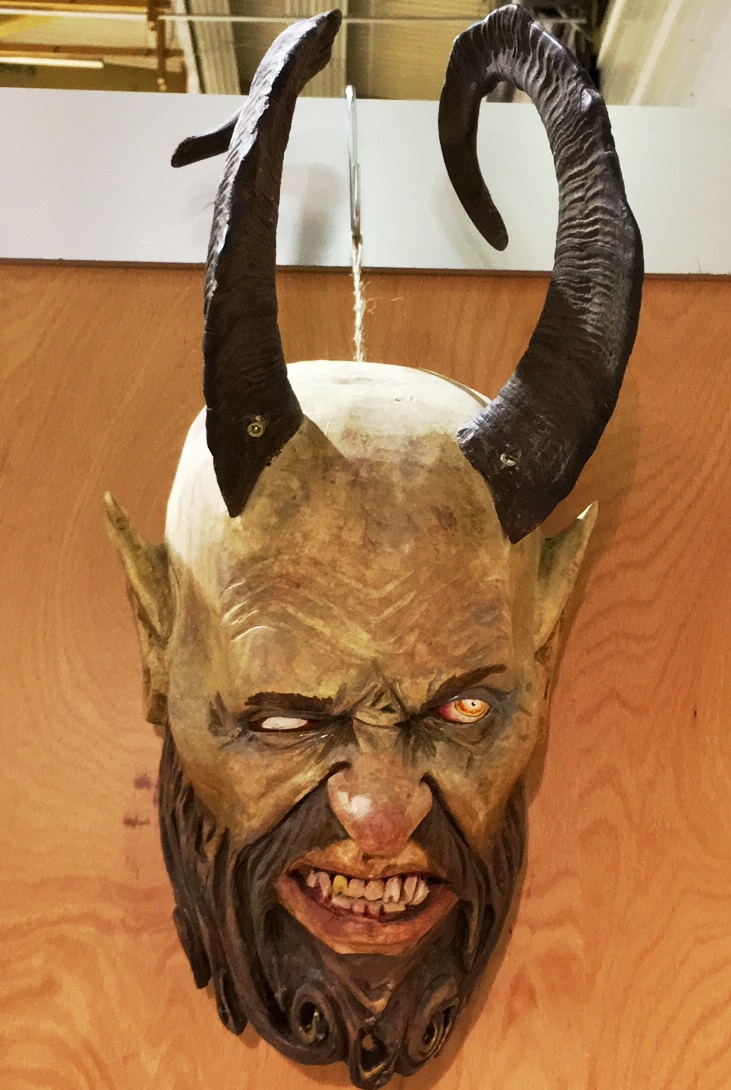
The mask is often the first thing a visitor notices. Hand carving gives wood an expressive face: brows, teeth, a nose, a beard or a highly individual shape. Horns and fur complete the outline, while bells make the figure audible before it comes into clear view. Chains may also appear as symbolic costume elements. Materials and styling vary between groups and regions.
Some areas use the term Larve for a mask. It is a regional word worth learning when it appears in a local exhibition or explanation, rather than a label to apply without distinction to all Alpine costumes. A close look at a publicly displayed mask can reveal tool marks, paint and construction that are difficult to appreciate during a noisy evening procession.
Costume making involves decisions about movement as well as appearance. A wearer has to carry weight, see through restricted openings and coordinate with others. Give participants room. Touching a horn or pulling at fur can affect the person inside, damage carefully made equipment and turn a respectful encounter into a dangerous one. Ask for a posed photograph only when the group is stopped and willing.
The people behind a Pass
A Pass is a group associated with the custom; Passen is the plural. Local associations prepare costumes, organise appearances and maintain relationships with their town and neighbouring groups. Their work is not limited to the few minutes in which a visitor sees them pass. Rehearsal, repairs, administration and discussions about tradition all contribute to the public evening.
Watching several groups rewards patient attention. Notice differences in silhouettes, bell arrangements, pace and how members acknowledge one another. In Salzburg’s description of its traditional run, greetings between groups include chain pulling and the rubbing of furs and bells. That is a local description of an organised encounter, not an instruction for spectators to join in or copy it.
The group identity can be as important as an individual mask. A banner, coordinated costume style or familiar rhythm may identify a community that has spent substantial time preparing. Resist treating every participant as an anonymous frightening figure. Behind the appearance are people with names, practical responsibilities and their own views about how their custom should develop.

Krampus, Perchten and regional differences
Krampus and Perchten are related in some contemporary practice, but they should not automatically be treated as interchangeable terms. Their historical associations and seasonal settings differ, and local usage can overlap. Salzburg’s current programme, for example, advertises its December Krampus run separately from a later Perchten run. Check which event is actually being described before booking.
Tyrol includes distinctive names and styles, while Carinthia, Styria and the Salzburg region have their own traditions. Bavaria and South Tyrol add further variation across the wider Alpine setting. A photograph taken in Munich or at an exhibition can help illustrate that range, but it is not a photograph of a Salzburg event. This page labels those contexts separately.
Nor should a visitor assume that a large city run is more authentic than a smaller gathering, or the reverse. Different communities choose different public formats. A clearly organised procession with announced access and stewarding can be an appropriate introduction, especially for a first visit. The strongest choice is one you can understand, reach comfortably and attend without intruding on private activities.

Tradition in a contemporary world
Modern runs may combine inherited costume forms with amplified sound, smoke, lighting or other theatrical elements. Some groups welcome that development; others prefer stricter local conventions. International film, online imagery and tourism have also increased recognition of Krampus. Popularity can create opportunities to explain the culture, but a dramatic clip gives only a narrow view of an entire seasonal tradition.
Keep that distinction in mind when choosing an evening. A ticketed show, a commercial party and a community procession may share visual references without offering the same experience. Read the organiser’s description, ask about suitability and respect the boundaries it sets. Children and visitors sensitive to noise or frightening imagery may prefer a specifically advertised St Nicholas or family programme.
A rewarding visit leaves space around the procession. Explore the town in daylight, see an appropriate craft display, eat before the main crowd gathers and arrange the return. The bells and masks then become part of a place you have begun to understand. Krampusnacht is most meaningful when the image, the seasonal context and the local people remain connected.
2When & Where
Compare the current Klagenfurt and Salzburg events with the wider regional calendar.
When Krampusnacht Happens
The traditional date is 5 December, with St Nicholas Day on 6 December. Organised events also take place in November and on nearby Advent dates. Do not travel on 5 December assuming every town’s major run happens that night.
Austria’s Krampus Traditions
The existing page’s Klagenfurt focus remains relevant. The official destination programme lists its 35th-anniversary Krampus procession on 21 November 2026 from 19:00. Confirm the final route, closures and public viewing guidance before travel; a previous year’s start point is not a current access map.
Krampus Runs
Salzburg’s market organiser lists the traditional run at Domplatz on 5 December 2026, provisionally around 19:00. This resolves conflicting older tourism text mentioning 18:30. Recheck the organiser’s final notice. The separately listed Nikolo and Kinderkrampus event is 6 December at 15:30; the Perchten run is 21 December at 19:00.

Town & Village Celebrations
Tyrol, Carinthia, Styria and the Salzburg region offer additional local events. Gastein’s household and village customs are not an invitation to enter private homes. Use a current public listing and ask about audience suitability, barriers and expected interaction. Bavaria and South Tyrol have their own calendars.
St Nicholas & Krampus
Some programmes bring the saint and accompanying figures together; others concentrate on a run. A family event should be identified by the organiser, not inferred from the presence of children in an old photograph.
Best Places to Watch
Use designated spectator areas with a clear exit. Stay behind barriers and leave room for heavy costumes and any fire elements. Detailed 2026 route maps, accessible allocations and closure timings were not verified for this guide.
Best Time to Arrive
Arrive in daylight, explore the centre, eat and locate the permitted viewing area before the announced start. The evening may include gathering, St Nicholas activity where programmed, the procession, a crowded peak and managed dispersal. Allow a winter-weather buffer and confirm your last train or bus.
3Festival Advice
Prepare for winter streets, loud bells, crowds and fast-moving costumes.
Choose the right public event
Ask the organiser about crowd density, audience interaction, fire effects, age guidance and accessible viewing. A large run can be loud and intense. Do not assume every event is suitable for young children; hearing protection and a position with an easy exit may help sensitive visitors.
Respect the route and participants
Stay outside the active procession. Bulky costumes can restrict sight and movement, while bells, horns and torches need clearance. Never pull a mask, grab fur or block a group for a photograph. Follow stewards and avoid encouraging physical confrontation.
Prepare for winter streets
Wear warm layers, waterproof outerwear, hat, gloves and shoes with grip. Snow, rain and ice are possible rather than guaranteed. Keep valuables minimal and a phone available for your return. Book accommodation early if staying in a popular town.

Common Mistakes
- Assuming all runs take place on 5 December or share the same customs.
- Taking children to an intense event without checking suitability.
- Standing in the route or grabbing a mask for a photograph.
- Underestimating bells, crowds or slippery paving.
- Arriving late and expecting a front-row view.
- Treating members of a local association as horror-attraction staff.
Transport and a comfortable return
Check road closures, parking and evening timetables. A taxi may need to meet you beyond the controlled centre. Staying overnight is often more comfortable than a late drive in poor weather. Avoid excess alcohol and leave if the crowd or noise becomes uncomfortable.
4How to Experience
Combine an organised run with local craft, history and an unhurried Alpine stay.

Essential Krampusnacht Experience
Choose one confirmed public run in Klagenfurt, Salzburg or another documented location. Arrive early, learn its St Nicholas connection and watch from the designated spectator space. Give several groups time to pass before leaving along the official route.
Full Alpine Experience
Stay for a winter weekend, explore the town in daylight and combine the run with an operating Christmas market or local cultural visit. Confirm each activity separately; a village’s private customs are not an open visitor programme. Keep the day manageable and allow warm indoor breaks.

Best Cultural Experience
Look for a public mask exhibition, a craft demonstration or an association’s explanation of its own history. Notice regional carving styles, bells and group identity. Ask respectful questions while people are free to speak, rather than interrupting an active procession.
The strongest experience comes from understanding Krampusnacht as an Alpine community tradition. A quieter encounter with a carver or local account can add as much as the most dramatic evening photograph.
5Photo Guide
Photograph masks, groups and winter atmosphere without entering the active route.
Best Subjects
Carved faces, horns, bells, fur texture, groups and the winter street together tell a broader story. Include St Nicholas where he is part of the actual programme.
Best Light
Daylight preparation or a public exhibition reveals craftsmanship. Early evening preserves street detail; full darkness emphasises available lighting and torchlight.
Best Positions
Use the official spectator side, with room to move away. Do not step into the route or lean towards horns, bells or flame.
Krampus Run Photography
Start around 1/250 second for moving figures, raising ISO as needed. Short bursts help; slower exposures can deliberately show movement from a safe stationary position.
Mask & Costume Photography
Ask permission for posed portraits when the participant is stopped. A museum or public display is better for detail than an intrusive close-up during a run.
Torchlight & Night Photography
Protect bright flame highlights and accept some shadows. Avoid distracting flash and follow event rules. Never bring your own fire effects.
Alpine Street Photography
Include architecture, spectators and group formations. Respect residents and avoid photographing distressed children or unwilling people closely.
Phone Photography
Clean the lens, use a short burst and avoid excessive digital zoom. Long night-mode exposures blur moving masks. Keep spare power warm inside your coat.
What Not to Do
Do not grab costumes, block performers, climb barriers or enter private property. Never launch an unauthorised drone. Put the camera away when moving through a crowded exit.
Practical Information
Choose a suitable run, dress for winter and confirm your return before the bells begin.
Best Time to Arrive
Arrive in daylight and confirm the actual event date.
How to Get There
Use rail, local buses and permitted walking routes.
What to Bring
Warm waterproof layers, grippy footwear and a charged phone.
What to Expect
Loud bells, heavy masks, crowds and strongly local customs.
Best Time to Arrive
Arrive before darkness and the published start, allowing for closures and a walk from transport. Confirm whether the event is on 5 December or another date. Locate an exit and warm indoor stop before crowds build.
How to Get There
For Klagenfurt, use Klagenfurt Hauptbahnhof and current KMG services or licensed taxis. Klagenfurt Airport lists bus access opposite arrivals and onward transfer options. Check the parade-night diversions: no final 2026 closure plan was verified.
For Salzburg, rail arrives at Hauptbahnhof. Airport guidance lists bus 2 to the main station and bus 10 towards the centre; check the date-specific timetable. Walk into the Old Town along permitted routes. Regional rail and buses can reach Alpine towns, but evening returns may be limited.
For Innsbruck or another Tyrolean event, use the exact town’s public listing and transport planner. Do not substitute a Salzburg timetable. Allow for winter driving, limited parking and a taxi pickup beyond barriers.
What to Bring
Warm coat, layered clothing, hat, gloves, waterproof shoes with grip, phone, power bank, rain or snow protection and a small secure bag. Bring hearing protection for sensitive visitors and children where appropriate. Carry minimal valuables and only permitted camera equipment.
What to Expect
Carved masks, heavy fur, loud bells and fast-moving groups can create an intense atmosphere. Torches or theatrical effects appear only where programmed. Winter cold, crowded streets and controlled routes require patience.
Local participation and St Nicholas customs give the evening its context. Atmosphere and family suitability differ substantially between towns.
Photo Gallery
Nineteen credited photographs and one clearly labelled 1896 illustration: processions, masks, groups, exhibitions and regional St Nicholas context. Images show earlier occasions.


Current information and sources — reviewed 7 November 2026
Reviewed 7 November 2026. Current events: Klagenfurt official Advent programme (21 November, 19:00); Salzburg market’s 2026 dates and organiser FAQ (5 December, approximately 19:00). Final routes, closures, age rules and accessible viewing must be confirmed locally.
Culture: Tyrol’s museum-informed traditions account, Austria Tourism, Gastein Tourism, Zillertal and Salzburg cultural lexicon. Transport: Salzburg Airport and Klagenfurt Airport. Archival photographs do not establish this year’s route, costume style or audience arrangements.
Photo credits and licences
Archival photographs show earlier editions. Local-context and museum images are labelled separately. Images use responsive cropping. Banner supplied by the site owner.
- Morzger Pass in Salzburg, 2008 — archival procession — User:MatthiasKabel. CC BY-SA 3.0. Source and original.
- St Nicholas and Krampus visiting an Austrian household — 1896 illustration — Unidentified illustrator, 1896. Public domain. Source and original.
- Hand-carved wooden Krampus mask from Carinthia — Naturpuur. CC BY-SA 4.0. Source and original.
- Veldener Feuer-Teufel at Pörtschach, 2013 — Johann Jaritz. CC BY-SA 3.0. Source and original.
- Morzger Pass in Salzburg, 2008 — costume and community — User:MatthiasKabel. CC BY-SA 3.0. Source and original.
- Krampus run on Munich’s Marienplatz — Bavarian context — Alessandro Caproni. CC BY 2.0. Source and original.
- Krampus masks in an exhibition — craftsmanship context — Jernej Furman from Slovenia. CC BY 2.0. Source and original.
- Morzger Pass, Salzburg 2008 — archival scene 02 — User:MatthiasKabel. CC BY-SA 3.0. Source and original.
- Morzger Pass, Salzburg 2008 — archival scene 03 — User:MatthiasKabel. CC BY-SA 3.0. Source and original.
- Morzger Pass, Salzburg 2008 — archival scene 04 — User:MatthiasKabel. CC BY-SA 3.0. Source and original.
- Morzger Pass, Salzburg 2008 — archival scene 07 — User:MatthiasKabel. CC BY-SA 3.0. Source and original.
- Morzger Pass, Salzburg 2008 — archival scene 10 — User:MatthiasKabel. CC BY-SA 3.0. Source and original.
- Poertschach Krampuslauf Fuersten der Finsternis 29112013 674 — Johann Jaritz. CC BY-SA 3.0. Source and original.
- Poertschach Krampuslauf Krampusrunde Unterloibl 29112013 860 — Johann Jaritz. CC BY-SA 3.0. Source and original.
- Perchten at the Pörtschach run, 2013 — related tradition — Johann Jaritz. CC BY-SA 3.0. Source and original.
- Wooden Krampus mask from Carinthia — carved detail — Naturpuur. CC BY-SA 4.0. Source and original.
- The Carinthian Bartl — regional mask tradition — Naturpuur. CC BY-SA 4.0. Source and original.
- Salzburg Schiachperchten and Krampus association group portrait — ByteBros. CC BY-SA 4.0. Source and original.
- St Nicholas railway outing in Bezau, Vorarlberg — regional seasonal context — Asurnipal. CC BY-SA 4.0. Source and original.
- Krampus procession in Wiesing, Tyrol, December 2024 — LensaCibi. CC BY-SA 4.0. Source and original.
