Angkor Wat
Table of Contents
Show
Overview:
The symbol of Cambodia, the Angkor Wat Temple complex is an awe-inspiring 12th century sandstone collection of temples, cities and sanctuaries that feature stunning carved architecture and galleries, which tell the story and legends of the Khmer Empire alongside towering statues, iconic doorways, untouched mausoleums and arguably the best sunrise in the world – which helps make Angkor Wat Temple complex a truly magnificent wonder of the world.
Earning the title of the worlds biggest religious complex and clocking in at 402 acres, the Angkor monuments have been in constant use since their construction in the 12th century, with the construction of the grand temples and the incredible carvings believed to have been the design of King Suryavarman II and carried by over 400,000 works and some 8000 elephants who ferried sandstone down the Siem Riep river on rafts and constructed what was at the time a thriving holy city that paid homage to the Gods.
The beauty of the Temple Complex, which features more than a thousand individual temples was bought to western attention due to the starring role of the untouched jungle of Ta Prohm and the iconic fig tree and ancient doorway in the Lara Croft films – with the entire temple complex now being easily discovered by hopping in a local Tuk Tuk as your journey from temple to temple to witness not only the incredible and sheer beauty of the Angkor Wat Sunrise but discover the history of the Khmer Empire and explore the many stunning temples of the true wonder of the world that is the Angkor Wat Temple Complex.
Where:
The Angkor Wat Complex stands as the national symbol of Cambodia and is best reached by Tuk Tuk of tour from the main town of Siem Riep which is 15 minutes away and features all the comforts a traveller could ask for.
Getting there:
Having made your way to Siem Reap – either by international or national flight or by Bus from the Cambodian capital of Phnom Penh, you’re left with a few options to get to Siem Reap.
First up, and unquestionably the best option is to get a Tuk Tuk direct to the wonder, this is our favored option as not onloy does it put the $20 usd direct into the pocket of a local, but the tuk tuk driver will stay with you for the whole day, from sunrise to sunset and ferry you round all the sites of the Angor Wat Complex at your convenience – allowing you to explore the wonder at your own pace – just be sure to reserve your Tuk Tuk the night before if you’re heading to the sunrise.
Alternatively, you can book a tour that will ferry you to both the sunset, and to the major sites of the wonder from Siem Riep, while more expensive the tours are always reliable and will provide snacks, water and towels to help you enjoy the wonder in more comfort – so it’s really your call on how best you wish to explore the wonder !


Best time to Visit:
We’d recommend visiting between October – January, with a trip to the Angkor Wat Complex recommended in October – November where you run the risk of slight rain but avoid the peak tourist season of December – January and should be in for more manageable temperatures.
It’s highly recommended to avoid visiting between March – September as you run the risk of either incredibly uncomfortable high temperatures or the brunt of the Monsoon season – both of which can really take away from the enjoyment of the Angor Wat Complex.
We’d also really encourage visiting in the early morning – at latest 5:30am to catch the incredible sunrise over the main Angkor Wat complex before spending a few hours at the main Angor Wat temple, then heading back to the hotel for a few hours rest before heading out to see Angkor Thom, Ta Prohm and the rest of the stunning temples in the complex in the early afternoon when it’s likely to be both quieter and cooler.
Explore:
As the biggest religious structure in the world that clocks in at 402 acres, it’s not surprise that Angkor Wat has enough sites, temples and statues to explore over the duration of a full week.
However the main sites of the incredible Angkor Wat schedule on three main temples, with four stunning and incredible experiences, which can be explored and experienced over one long day, and would be our top picks to experience to immerse yourself in the incredible wonder that is Angkor Wat.
Sunrise at Angkor Wat:
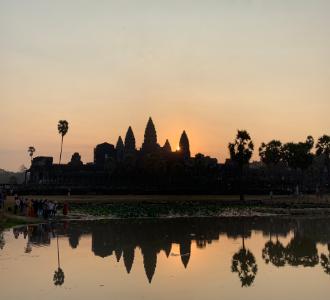
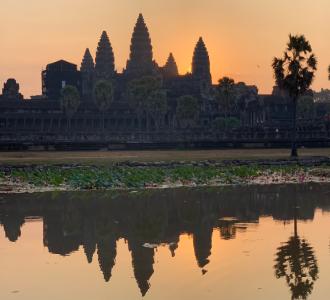
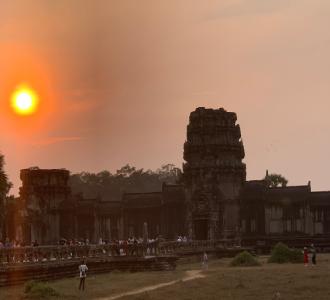
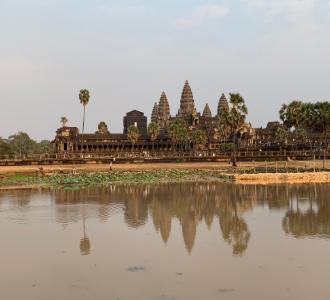
The truly iconic and awe-inspiring experience of Angkor Wat – and one for the photo purists, witnessing the sunrise is a true bucket list experience. You’ll have to be up early – arriving at the wonder for at least 5:30am if not before and be prepared to bustle with hundreds of others for a great photo spot – especially in front of the lakes in front of the Temple.
The lakes for the best view are found from the main entrance (your tour guide or tuk tuk driver will drop you off there) and you will need to keep warm, but as the sun slowly ascends to light the temple, and you experience the first glimpses of the incredible Angkor Wat reflected in the lake in front of you, it’s truly an awe-inspiring experience, and sets the tone for the rest of the day exploring the unique wonder of Angkor Wat.
Angkor Wat:
After the sun rises, we’d advise continuing on to explore the temple, as you’ll see a lot of people head back to their hotels to get some sleep – leaving some areas of the temple and the grounds deserted before a mass influx of bussed in tourists.
Starting from the lakes, you’ll head along a stunning bridge dotted with beautiful statues which provides great photo spots of the main temple towards the main three-tiered temple, and you’ll notice both the incredible sheer size, large outer walls, a large statue of the god statue of Vishnu, and a 190 metre wide moat that surrounds the stunning temple.
As you enter at the main tower – called a gopura, of which Angkor Wat has 5, all of which stand at least 12 foot tall and reach the top level and feature incredible carvings and are architectural wanders of the Khmer Empire from the 12th century.
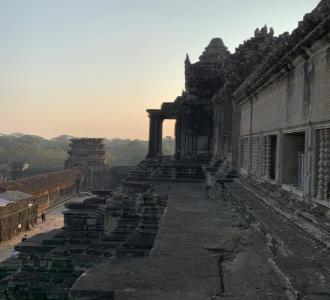
Upon entering, we’d advise heading into what was once the library and spending some time on the first floor passing through the various rooms and taking in more than 3,000 incredible carvings in the wall, which depict acts of history, mythological beliefs and battle scenes – with the most stunning being the battle of Ramayana and a depiction of battles between gods, including those of Vishnu.
These stunning drawings are notable for their immense detail, with the carvings stretching round 800 metres of the incredible temple and being used as a stunning historical document and testament to the immense skill of the architects of the temple.
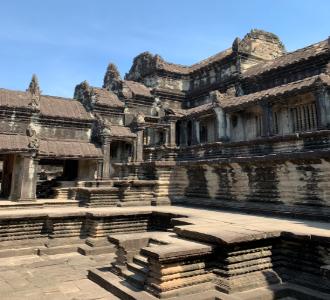
From the first floor, you can venture outside through one of the 5 gopuras again to observe the temple from the ground level inside the temples ground for another great photo, before ascending up to the second level of the temple where you’ll find further temple rooms, more stunning architecture and the gallery of a thousand Buddhas – which will immense is sadly lacking in Buddhas due to depletion by war and the passage of time, with today only a few Buddhas remaining in the gallery.
Ascending higher and up some steep steps and you’ll come to the third and top tier – which is known as the Kingdom of the Gods and which opens out into a stunning courtyard, from where you can enter further temple ruins, explore further temples and visit the incredible Bakan Sanctuary – which is the highlight of Angkor Wat, and requires you to climb some steep steps, with entry by queuing only and a strict dress code enforced for entry.
Once you make the steep Climb, you’ll find yourself at the summit of the worlds largest religious temple, and the place that is believed to have served as a temple and tomb for Suryavarman II – with the stunning design of the inside of the temple making it truly a place for Kings – with the views from the Bakan Sanctuary that look down on the rest of the incredible main Angor Wat complex providing an ideal place to stop and take in this true wonder of the world.

Angkor Thom:
The Great City, Angkor Them should be next on the list of sites to explore at the Angkor Complex, with this being the once home of the citizens of the Khmer Empire and standing as a lasting memorial and historical insight into their walls.
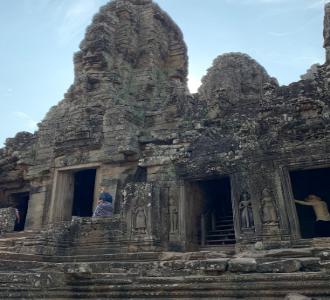
Alongside featuring stunning temples that all date back to the 12th century, the highlight of Angkor Thom is undoubtedly the Bayon Temple, a magnificent rock carved temple that features some of the best sites of Cambodia and where you’ll find incredible carved architecture and the famous towers of Bayon, which once served as guard towers.
As you enter the Bayon temple, we’d highly recommend taking your time to explore the galleries on the lower two floors and then making your way to the summit to the third and top level which is the central sanctuary and from where you can see carvings of every day life in the Khmer Empire from the great city – and look out over what was once a thriving and incredible city that stands as its own unique wonder.
Alongside the Bayon city, you’ll find the aptly named Elephant Terrace where alongside being offered an elephant ride through the city, you can stand at a spot that was once used for public ceremonies – with incredible and unique carved lines dotting the way of the Terrace – which makes for incredible and stunning photos.
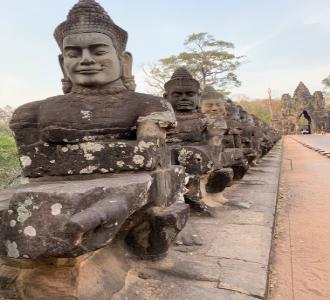
For those who want to explore the lost city in more depth and get a true understanding of the scope of the city, we’d recommend checking out the 5 stunning gates to the great — with the victory gate in particularly being incredible with exquisite carved architecture and it is from here that we would suggest traversing the entire lost city from gate to gate to truly take in the magnificence of Angkor Thom.
Ta Prohm:
A short tuk tuk ride from Angkor Thom you’ll come to Ta Prohm an incredible untouched Temple complex – that is a photographers paradise and perhaps one of the most famous temples in the world, with the overgrown strangler fig tree and stunning doorway coming into international attention due to its staring role in the Tomb Raider Films.
Starting at the main entrance to Ta Prohm, you’ll notice the incredible stonework and architectural beauty of the temple and the overgrown natural Jungle appearance of the Temple with the overgrown trees and vines adding to the charm of the Ta Prohm complex.
As you journey in through the temple following a central route, you will notice that queues begin to form at both the amazing fig tree – which is close to the stunning doorway – as people pose for the perfect photo, once you enter through the doorway you’ll come to a courtyard and what was once a library and place of reflection where more exquisite atchitecture and stone buildings and temples await you.
While some of Ta Prohm is cordoned off – as a result of ongoing and constantly needed restoration work to address the overgrowth of Vines and its slow decay of the stunning complex, a visit to Ta Prohm and grabbing photos of and exploring the incredible ruins of the complex – which helps round off an incredible visit to the awe-inspiring and truly unique wonder of the world that is the Angkor Wat Complex.
How long to stay: For the most enjoyable experience we’d recommend splitting your visit over one long day or two days, with the first day dedicated to being there at sunrise to see the incredible rising sun over the main temple and then taking in the rest of the main temple, before having a rest and letting the midday sun pass – and then returning in the afternoon when the weather is cooler and you’re refreshed to explore Angkor Thom, Ta Prohm and the rest of the incredible temples and statues that make up Angkor Wat.
Top Tip:
As with all temples, it’s important to dress appropriately (cover your shoulders and knees) and try to avoid the classic tourist elephant trousers that are frequently seen by western backpackers in asia – as as well as making you a target for scammers, and not looking great they are borderline on whether they’ll be accepted by those wearing them into the temple.
There’s also a strict enforcement of not touching, climbing on or jumping on the temple, as it is considered a holy site and national symbol for the people of Cambodia – so avoid entering restricted areas, no matter how tempting it can be.
Finally for those who arrive or are at the temple after the sun rises, expect to see hoards of Monkey at the gates and on the ground of the temple, and be warned they will steal electronics, passports and food if given the chance, so we’d advise keeping a safe distance and not trying to pat them.
Cost:
Assuming you’re going by Tuk Tuk both to and around Angkor wat from a hotel in central Siem Reap – and you’ve booked one the night before, expect to pay $20 usd for the Tuk Tuk – which will cover you for the whole day – for booking you can easily just either flag one down, or reserve and speak to one the night before who will pick you up from your hotel.
For the cost of visiting Angkor Wat itself, you can arrive between 5am and 6pm and expect to pay either $40 usd for a one-day pass or $65 for a three day pass – which the one day pass giving you the option to arrive for sunrise, spend a few hours at the main temple, head back to your hotel for a sleep and then return later in the evening when you’re refreshed.
Which accounting a few dollars for food and $10 usd for a decent guide should put a one day experience in Angkor Wat at around $80 Usd – a bargain to see the incredible wonder.
Fun Fact:
Alongside being the famous filming location of the Lara Croft Tomb raider films (and you can find the famous tree and temple entrance at Ta Prohm for a novelty photo spot), Angkor wat is also the scene for multiple other films, including Transformers 3: Dark of the Moon, Two Brothers and our personal favourite the 1936 film Revolt of the Zombies.
Best photo spot:
While the whole of Angkor wat is stunning – unquestionably the best photo spot is witnessing the majestic sun rise at the Angkor wat complex, you’ll have to get there early (around 5:30am) and expect to jostle for position in front of one of the two lakes to grab the perfect shot, but it’s truly a magnificent and awe-inspiring way to witness the incredible wonder of the world that is Angkor Wat