The Grand Palace & Wat Phra Keo
Overview:
The jewel of Thailand, the Grand Palace is a stunning series of buildings, temples and monuments found in the heart of Bangkok, which has been home not only to the King and government of Thailand for more than 200 years, but which also houses the awe-inspiring, spiritual and revered Wat Phra Kaew temple ‑within which sits the holy jade emerald statue of Buddha considered that most religiously significant monument in the whole of Thailand.
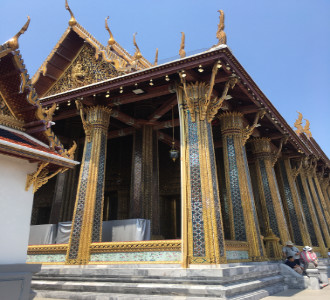
Constructed in the 18th Century by the Thai King Rama the First, the Grand Palace complex houses more than 100 different buildings and is known for the stunning gold spirals and incredible Thai and European architecture, which while not only being historical monuments that tell the incredible story of Thailand – make for a dazzling site when viewed at sunrise.
Although some of the complex is off limit to the public – as the Thailand King hosts a series of banquets and visitors within the grounds of the wonder, the Grand Palace is still an incredibly popular site in Thailand – with more than 8 million people flocking to the wonder each year – which is no surprise given the stunning temples, incredible architecture, and the awe-inspiring Wat Phra Kaew temple which help make the Grand Palace of Thailand not only the countries spiritual home but a truly incredible and immense wonder of the world.
Where:
The wonder of the Grand Palace is found in the centre of Bangkok – in the old city on the banks of the Chao Phraya River that runs through the heart of the capital of Thailand.
Getting there:
With the Grand Palace being found in the heart of Bangkok, having got yourself to Bangkok (easily done by direct flight or by train from anywhere in Thailand) you can taken the easily accessible sky train to Saphan Taksin station – and then jump on a river boat to Elephant Pier – which will give you some stunning photos of the wonder as you approach it form the water – especially at sunrise.
Alternatively you have the option of walking there directly from your hotel, or jumping in a tuk tuk or taxi from anywhere in Bangkok – although you can expect to haggle and possibly argue with your driver over the price.
Best time to Visit:
You’ll find the Grand Palace is busy all year round, so what we’d recommend for the best time to visit is to make sure you get there as soon as it opens at 8:30am – when the wonder will be quieter and the bus loads of yoursits that tend to arrive at 10am have yet to arrive.
For those who want to combine a visit to the wonder with the incredible Songkran festival for Thai New Year – and get a visit into The Pantheon to witness the life size statues from the Chari era, then timing your visit for the first week of April is recommended.

Explore:
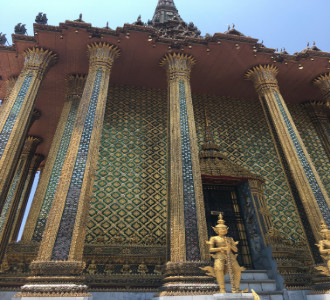
Spread across more than 2 million square foot, the Grand Palace is an incredible and stunning complex, filled with temples, statues, architecture and history.
The entire complex is split into three separate bits to make exploring easier; the inner court, the central court and outer court – with the outer court in particular being the main section for explorers being both accessible and home to the stunning Wat Phra Kaew and the famous Emerald Buddha Statue.
Inspired by the unique wonder of Ayutthaya (Wat Mahathat) and set agains the stunning Chao Phraya River – which at one time acted as a Moat as a line of defence to protect the Grand palace, the below are our pick of highlights from the more than 100 buildings in the Grand Palace Complex:
The Outer Court:
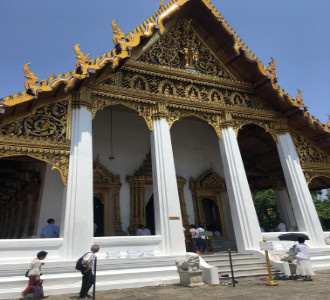
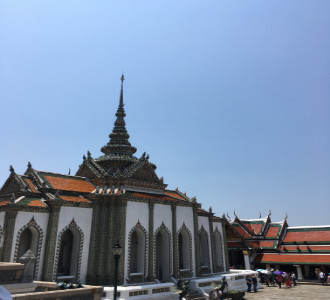
Starting with the outer court from where you will initially enter the temple grounds, you’ll find prestigious buildings – designed in both traditional Thai and European architectural styles, with the outer court once serving as the governmental administration of Thailand and still serving today in an official governmental capacity.
While there are a series of incredible temples and golden spirals in the outer court, you’ll also find the Temple of the emerald Buddha (Wat Phra Kaew) located in the corner of the outer court, and we’d recommend heading straight here if you’ve arrived early – to give you the best chance to soak in the incredible stature before crowds form.
Wat Phra Kaew – Known as the temple of the Emerald Buddah, Wat Phra Kaew is home to the famed Jade Emerald Buddha – considered Thailand’s national symbol and a sacred place for Buddhists.
The Temple itself sits inside the ordination hall of the Grand Palace, which is eaily found in the corner of the Outer Court as it is protected by two giant statues who guard both the temple and the statue – with the temple and the statues both being exquisite piece of architecture. Visitors who pass through the guards are then encouraged to take a moment to reflect and pause, and take in the poems and teachings of Buddha which are depicted on the passageway into the hall where a small stupa – which according to legend contains a piece of Buddha sits.
Upon entering the Temple of Wat Phra Kaew, you’ll need to observe and respect your surroundings and stay silent, and from a distance – as only the King of Thailand is allowed close to the incredible statue – you’ll be able to observe and take in the incredible and awe-inspiring Jade statue of Buddha which lies carefully in the lotus position, and is made up of shimmering green Jasper stone and clothed and carved in solid gold.
Believed to have been carved in the 15th century, the 25 inch statue sits towering on a platform and will be heavily guarded, with anyone who attempts to cross the rope line being severely dealt with. For those who observe the statue closely you’ll notice a distinct coloured robe dressed over Buddha – which is again an important element of Thai Culture – as the robe changes each season in line with Thai Culture and the changing of the Robe which happens three times a year and is only allowed to be performed by the King of Thailand believed to bring good fortune to the people of Thailand.
We’d recommend taking a few moments when laying eyes upon the Buddha to not only pay respects, but take in the incredible and beautifully carved icon that lies before you, before exiting the temple and continuing on with your exploration of the Grand Palace.
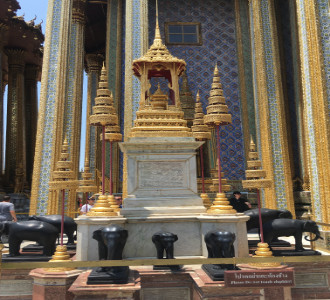
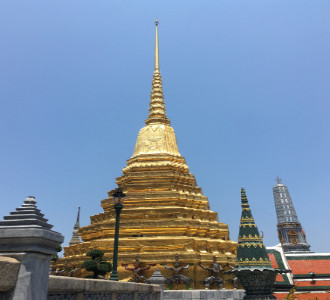
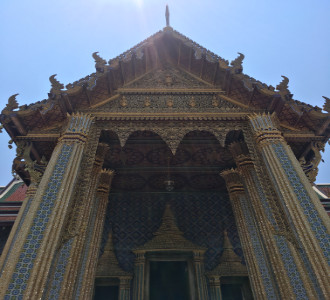
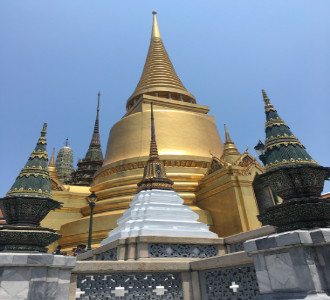
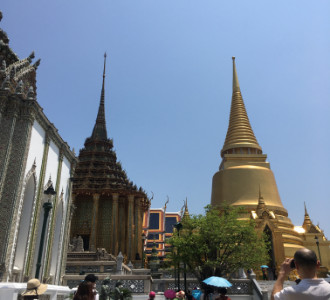
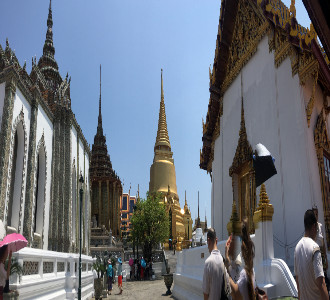
The Pantheon – Prasat Phra Thep Bidorn – Continuing inside the outer court you’ll notice the Royal Parthenon which is one of the grandest and most exquisite buildings in the grand Palace with two distinct gold Spirals and stunning statues.
This Pantheon once held the statue of the emerald Buddha but as a result of architectural miscalculations making it too small and a small fire which destroyed the interior. Yet since reconstructed the Pantheon now hosts statues of previous Thai kings from the Chakri era – which are only viewable on one day a year on Chari Day – so we’d recommend making some time to view the incredible gold spirals and outside architecture which make for stuning photos before moving on around the Grand Palace Complex.
Royal Reception Halls – Only open when no ceremonies are taking place – the Royal reception halls sit inside the central court and are still used by The King of Thailand for important ceremonies, but get here on a quiet day and you’ll be able to enter inside the giant halls which are styled on those of the Royal Family in England – with a large antique throne found in the centre of the halls – inside the halls you’ll also be able to grab some stunning photos of the architecture inside the halls and we’d suggest taking a few moments to appreciate the halls unique splendour before continuing your exploration of the Grand Palace complex.
Boromabiman Hall: Further inside the Central court and next to the grand reception halls, you’ll find the incredible Boromabiman Hall which is currently home to visiting Monks to the Grand Palace and is an architectural wonder – with the European style again evident and the hall featuring stunning carvings of the four elements and four Indian Gods that are believed to bring good fortune to all who enter the hall.
The hall also looks out over the lawns of the Grand Palace – again a place off limits to all but royalty – and is the setting of the annual Kings banquet a great feast in which the king of Thailand treats his advisors, so for those who wish to visit be sure to time your visit outside the annual banquet.
Phra Mondop – Next up as you journey around the stunning Grand Palace Complex is the incredible stunning building of Phra Mondop. You’ll notice Phra Mondop as a small glass building made out gold patterns with incredible architectural patterns and a unique spiral. While access if off limit to the public – as the Phra Mondop hosts the sacred text and teachings of Buddha in their original form – the outside of the building which is a reflection of great Thai architecture is certainly worth a stop off to grab some stunning photos.
The Upper Terrace – Continuing your journey around the Grand Palace and you can wind your way up the upper terrace – where you will have stunning views of Wat Phra Kaeo. The Upper Terrace is also home to some incredible temples and buildings, including our personal favourite the replica of the wonder of Angor Wat.
Angkor Wat (Replica): Lying in the upper terrace is a stone recreation of the Cambodian based wonder of Angor Wat – which was introduced into the golden temple complex by the Thai King Rama the fourth that once sat inside his territory.
While of course not at the same scale and beauty as the true wonder in Cambodia, the Angor Wat complex inside the Grand Palace is a great wonder, and is surrounded by coloruful and beautiful temples, that were created to watch over and in reverance to this replica.
Having taken your time to explore the full beauty of the outer court and the stunning temples that lie within the Grand Palace complex including the Wat Phra Kaew temple, you’ll find yourself at the south end of the Grand Palace – and we’d advise before you head back to the entrance and into the bustle of Bangkok taking one last moment to grab some final photos soak in the beauty of the Grand Palace and this truly incredible wonder of the world.
How long to stay:
We’d recommend budgeting four hours to visit the Grand Palace – starting at 7am you have a chance to grab an incredible sunrise photo over the complex before grabbing some breakfast and then entering the palace complex, where once inside the two and half hours inside will give you enough time to visit the inner and outer courts and soak in the majestic beauty of the emerald Buddha before the crowds start to take over the wonder.
Top Tip:
We’d really recommend getting there as soon as the Grand Palace opens at 8:30am chances are even in the off season it’s going to be incredibly busy, and you’ll find that around 10 am bus loads of tourists are dropped off – which can detract from your overall enjoyment at the Palace.
You’ll also need to come prepared for the heat – with both sunglasses, suntan and water a must, but be sure to follow the strict dress codes that apply, as the grand palace is a holy site you’ll need to be covering your shoulders and knees – and anyone wearing flip flops will be automatically thrown out.
Finally and unfortunately, make sure to keep an eye on your belongings and be wary of scams that operate at the gates of the Palace – with the Grand Palace being a major tourist attraction there are unfortunately people who attempt to take advantage of visitors, either by offering false tours, false tickets or claiming the palace is closed and dropping you off in the middle of nowhere on the other side of Bangkok for extortionate fees – so make sure you have your wits about you when visiting this stunning wonder of the world.
Cost:
While most temples in Thailand are free to enter, the Grand Palace complex charges visitors 500 Thai Baht to enter – roughly $16 usd to enter, with an audio headset tour available for a further $200 Baht – we’d advise getting there early (the temple is open from 8:30am – 3pm) as audio tours are known to sell out fast on busy days.
You’ll also find many unofficial tour guides standing at the gate and hassling visitors offering tours – while we’d suggest avoiding these as the information given out by these guides is not always accurate, for those who do wish to get themselves a guide, expect to pay a further 250 baht.
Best photo spot:
While grabbing a spot of the Grand Palace the Emerald Buddha up close in the grounds makes for special photos – for a truly magical photo we’d advise grabbing a photo of the majestic Thailand sunrise or sunset over the Grand Palace complex – with the full beauty of the palace best seen from the banks of the river Chao Phraya River.