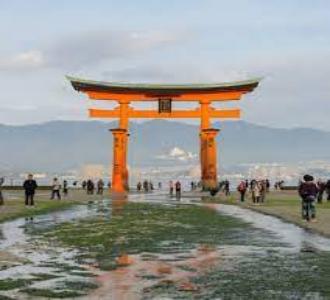
Itsukushima Shrine
Overview:
Sat on the Island of the Gods, the Itsukushima Shrine is home not just to one of the worlds most incredible and beautiful Shinto shrines, but the iconic and mystical ‘floating’ Torii Gate – that stands not just a place of ancient spiritual ceremonies but as a stunning and spiritually awe-inspiring wonder of the world.
Believed to have been constructed in 590CE, the Itsukushima Shrine sits on the majestic island of Miyajima, which was once considered the home of the Gods due to a belief that the island controlled the rise and fall of the tides, with the Itsukushima shrine – which features multiple shrines, prayer halls, worship rooms and stages, all constructed in traditional Shinto architecture and connected by traditional corridors — being specially constructed to ‘float’ on water so as to not only pay homage to the Gods, but so as not to disrupt them should the Shrine fall.
The Torii Gate itself sit’s just outside the Main Shrine and represents a passage between the spiritual and human world, with explorers encouraged to follow the bowing and clapping routine when passing through the Gate – which is best viewed both at High tide for the floating effect, low tide to walk up to it and at night time, when the Gate and Shrine are both illuminated to create a stunning effect – which combined with the lush forests, mountain peaks and free roaming deer that occupy the Miyajima island combine to make the Itsukushima Shrine a truly unique and spiritual wonder of the world.
Where:
The Torii Gate and the Itsukushima Shrine sit on the incredibly beautiful island of Miyajima, which is a short boat ride away from Hiroshima – a city in the south of Japan and earily reached by Bullet Train from Tokyo.
Getting there:
Having made your way to Hiroshima – you’re going to have to head to the pier and the ferry station to get to the island of Miyajima – which is achievable by taking the Sanyo Line from Hiroshima station to Miyajimaguchi Station and then jumping on a boat at the Pier – or by taking a taxi from anywhere in Hiroshima to Hiroshima Pier.
Once at the pier board the boat toward Miyajima Pier which should take 10 minutes and upon arrival at the pier it’s a 10 minute walk across the island to the entrance to the Itsukushima Shrine – which is unmissable from the Miyajima Pier.
Best time to Visit:
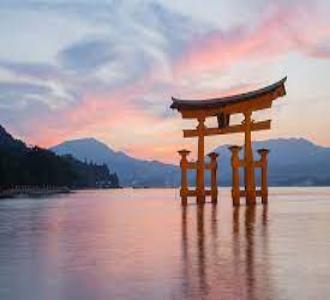
We’d recommend visiting in Autumn if possible, when you’ll get to experience the beauty of the Maple trees of Momijidani Park shedding their leaves and changing colour – also be sure to time your visit for both high and low tide if possible so you can experience both the floating effect of the gate at high tide and experience walking up to the gate at low tide to examine it up close – we’d also strongly recommend sticking around for the after sunset illumination of the Itsukushima Shrine, which is a truly stunning way to observe this incredible wonder of the world.


Explore:
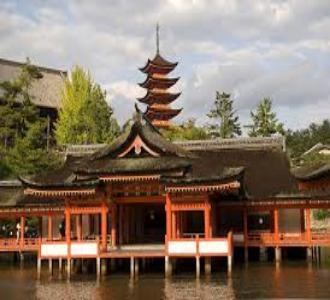
While the floating Torii Gate rightly hogs the attention of the sights on the Miyajima Island, there is a lot more to see, discover and understand as you visit the Itsukushima Shrine – with the shrine complex consisting of spiritual prayer halls, stunning pathways and incredible architecture – all of which if connected by unique Shinto boardwalks and pillars which is in unique harmony with the surrounding nature, and appears to float during high tide – all of which combines to create the unique wonder that is the Itsukushima Shrine.
The below are our top sights to visit when exploring this incredible wonder of the world:
East corridor
Having hopped off the ferry, and paid your Yen to enter the Shrine and said hello to the islands deer inhabitants, the first stop will likely be the start of the East Corridor – a National Treaure in Japan for more than 60 years and which is the corridor that extends from the entrance across the halls and prayers of the Itsukushima Shrine all the way to the main shrine.
This corridor, which is constructed in stunning typical Shinto architecture has been specially designed to compensate for the high tide buoyancy of the shrine and to alleviate flooding in the event of too much rain, as you journey along this incredible corridor and the traditional floordboards, you’ll being to experience the atmosphere and style of the complex as a whole as you head into your first shrine called Marodo.
Marodo Shrine
As you fork off from the east corridor the first shrine you’ll come to is the Marodo shrine, a shrine dedicated to five male gods (Amenooshihomimi-no-mikoto, Ikitsuhikone-no-mikoto, Amenohohi-no-mikoto, Amatsuhikone-no-mikoto and Kumanokusubi-no-mikoto) – with the Marodo shrine being the biggest of the four main shrines within the complex, and containing a unique purifying hall, where visitors are encouraged to take a moment to reflect on themselves and purify their mind and soul – with the shrine having an open hall facing the sea, allowing visitors to connect and observe the beauty of the sea.
Inside the shrine you’ll also see the stunning Shinto architecture and carvings of the temple, which continue as you journey out of the shrine into the famous Corridor lanterns – a series of corridors where lanterns used to hang to guide Shinto’s across the Itsukushima Shrine and into the Main Shrine of the complex.
The Main Shrine
Given it’s name, you’ll find it no surprise that the Main Shrine is the biggest and most impressive of the Shrine’s at the Itsukushima Shrine complex – with the shrine featuring incredible Shinto architecture, a worship hall and a purification hall – all sat against the stunning and serene natural backdrop of the Miyajima island – where the land meets the sea – with the Main
Shrine dedicated to three female gods (Ichikishima-hime-no-mikoto, Tagori-hime-no-mikoto and Tagitsu-hime-no-mikoto) whose influence is felt in the beauty of the shrine.
Clocking in at 271 Square metres, the main shrine is also one of the biggest in the entire country of Japan – and is believed to date back to the 1st century, with the styles of the Nara period seen in it’s crossbeams, roof and traditional floor – with their also being a notable lack of doors, which adds not only to the spiritual environment but allows more space for the purification hall – which was used for festivals – and the worship hall to be explored, where Shinto priests would gather for ceremonies, with the main hall itself being an incredible and wonderful temple that encapsulates the beauty of the Itsukushima Shrine.
Taka-Butai (High Stage)
Exiting the main Shrine – you’ll come to two stages, firstly the High stage where access is dependent on tides and which was used to perform and host Dances and the Hira-butai (Open Air Stage) which is found directly in front of the Main temple and was used to hold important ceremonies – which is a completely open air stage, constructed out of wood and stones, with access again being weather dependent, we’d recommend making some time for the open air stage, not just as a place to reflect but also as it offer stunning views of the outside of the main temple and the Torii Gate in the distance.

The Torii gate
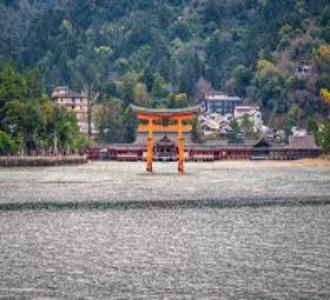
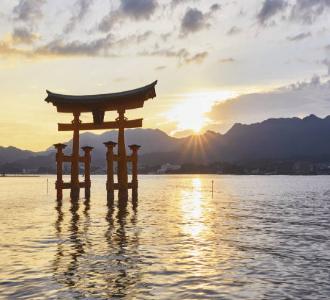
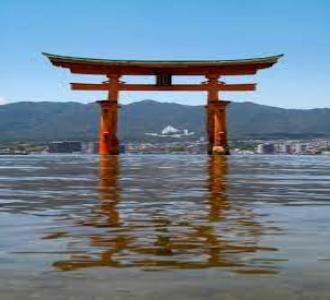
As you journey through the complex and past the main Shrine – you’ll come to the undoubted highlight of the Itsukushima Shrine complex – the famous floating Torii Gate. The Torii gate is found 200 metres away from the Main Shrine (and viewable from the main shrine) and has been rebuilt on a eight occasions, with the current gate believed to date back to 1875 and stands at 16 metres tall – as a unique and impressive symbol of the beauty of Shinto and Japan.
As you approach the gate you’ll notice not just the stunning architectural craftsmanship that created it, with the unique patterns and carvings along the trunks of the 700 year old trees that were specially sourced and make up the structure of the gate. Alongside taking in the beauty of the gate, you’ll also see that the six pillars that make up the gate are not embedded within the sea but use the stones and mud of the sea floor along with their own weight to maintain the gate’s balance, making it a true architectural feat — and which gives it the unique floating appearance at high tide and which makes the Torii gate a free standing gate.
Considered to represent the link between humans and the spirit world, we’d recommend visiting the gate once at low tide, when you can walk up to it and partake in the traditional bow and clap ceremony that each pilgrim is asked to observe when passing through the gate and also at high tide, when you can journey up to the gate in a boat to witness it’s unique floating appearance and truly observe this incredible wonder of the world and grab some incredible photos.
Mirror Pond
Alongside the stunning Torii Gate at the Itsukushima Shrine complex, for those who stay on Miyajima island for a full day, you’ll notice that the scenery around the gate changes as the tide rolls in and out – notably creating a unique effect called the mirror ponds – which are three round ponds found around the Torii Gate at low tide, and which according to legend represented the gods being please with the Shrine – and also served as a fire safety measure, for those that journey into the Itsukushima Shrine museum, you’ll hear and get to experience the poems and haikku’s written about the mirror ponds – and they are unquestionably well worth viewieng as they add further spitiuality to the magnificence of the Torii Gate.
The Itsukushima Shrine illumination
For those who want to truly experience the beauty of the Itsukushima Shrine and the Torii Gate, alongside staying for the famous sunset photo shot, it’s highly recommended to allow a little time in the evening to view the incredible illuminations of the temple complex after dark – when the entire the entire complex is lit up, recreating an old age tradition where candles would light the temple, and which creates not just a stunning sight with the gate visible in the dark and which you can observe from the pier of the temple or on a boat tour, but with the moonlight and the temple reflecting on the lake itself, a lifelong memory and unique experience of this incredible wonder.
Five-storied Pagoda
Outside the The Itsukushima Shrine complex, there are also three sites to check out on Miyajima island that we’d recommend that will add to your overall experience when seeing the wonder. The first is the fabled five-storied Pagoda — a Buddhist shrine constructed in the 15th century and which you can enter and walk around inside, with the shrine unusually constructed in a Japanese style.
Constructed to appease the gods of medicine, the shrine features stunning wooden pillars and internal walls, and coated in red paint stands out not just as a stunning temple but as a unique and beautiful architectural site that is well worth a visit on Miyajima island.
Mt. Misen
Representing the unique blend and pristine nature on the island, Mt Misen is the islands tallest mountain and is considered a sacred mountain that is worshipped in the Shinto faith since the temple’s construction. Alongside this, Mt Misen is also a great place to take a stroll, with its summit offering stunning views of the wonder of the world that is the Torii gate and The Itsukushima Shrine from above.
Up the mountain you’ll also find an incredible forest of trees, and some exceptional walking that allows you to explore the bits of the island off the beaten track – or for those who don’t fancy the trek up there’s a small cable car that will take you to the summit and the viewing platform where you can kick back and soak up the incredible views of the wonder of the world that lies beneath you.
Momijidani Park & Deer
Finally we’d really recommend exploring the Momijidani Park that lies in the heart of the island, not just for the hundreds of maple tree that transform in Autumn for a stunning show, but also for the many free deer that roam the park – and who are incredibly tame and approachable, unless you have Food on you ! in which case you can expect to have them accompany you on your time on the island.

How long to stay:
While it’s possible to see the Itsukushima Shrine and the Torii Gate in a couple of hours – we’d recommend doing it over the course of a long day trip, to allow you to fully explore the stunning temple complex and experience the Torii Gate both at low and high tide and in the day and evening time to truly take in and appreciate this unique wonder of the world.
Top Tip:
Alongside keeping your food away from the Deers ! – It’s strongly recommend to make sure you see the Torii Gate at high tide, so you can fully experience the floating gate effect and grab the iconic photos and explore the gate at low tide – when you can walk up to the Gate and experience it from close-up – as well as making time in the evening the view the illumination of the gate as it is stunningly lit up and sparkles against both the reflection of the lake and the glow of the moonlight.
Cost:
From Hiroshima expect to pay 180 yen one way from the mainland to the paradise of Miyajima island, and then following the brisk 10 minute walk from the pier to the Itsukushima Shrine you can expect to pay either 300 yen (3 USD) for access to the Shrine or 500 yen (5 USD) for access to the Shine and the Treasure Hall – with a visit to both recommended to truly experience this unique wonder of the world.
Fun Fact:
Alongside being the site of the unique wonder of the Itsukushima Shrine and the stunning floating Torii Gate, you’ll also find that Miyajima Island is home to another special feature – herds of tame and approachable Deer, that may pester you for food on occasion – with the Deer holding a special place in Japanese Shinto religion and believed to be re-incarnated Gods.
You’ll also find that Miyajima is home to another delight, the famous Momiji Manjyu – one for those with a sweet tooth the Manjyu is a freshly made multi-flavoured sugary treat, that makes for a delicious and well-earned snack after submitting Mt. Misen – just be sure not to give any to the deers !
Best photo spot:
Capturing the Itsukushima Shrine and in piacular the floating Torii Gate against the backdrop of sunset in high tide – with the Floating Gate effect in full flow — is the truly Iconic Photo of the wonder that is the Itsukushima Shrine and is viewable from both the waters edge of the island or from the main shrine itself. For those that want to grab an extra scenic photo of the whole of Miyajima – the trek up Mt. Misen accompanied by the beautiful Deer is another top place to grab a shot of this wonder.