

An Extraordinary Celebration of Fire, Community and Shetland Tradition
Lerwick’s Up Helly Aa brings a winter day of Jarl Squad appearances to a torchlit procession and galley burning. The Guizer Jarl leads Norse-inspired ceremony, while the wider guizer squads bring their own characters and performances.
Music, dancing and hall celebrations continue overnight. Behind the flames lies a year of shared work and enduring Shetland pride.
A town’s tradition, carried together.— THE TRAVEL LANTERN
Festival Guide
Explore Lerwick’s fire festival, community traditions and practical winter visitor guidance.
1Festival Overview
Understand the Guizer Jarl, squads, galley and community work behind Lerwick’s winter celebration.

Lerwick’s winter gathering
Up Helly Aa fills Lerwick with a particular kind of winter energy: anticipation in the morning, movement through the streets, a sudden glow of torches after dark and celebrations that continue indoors. Its most familiar image is a Norse-inspired galley surrounded by fire. Yet the event makes more sense when you also notice the people waiting for a relative, the musicians keeping time and the volunteers managing another busy part of the day.
This is a Shetland community tradition with visitors welcome as spectators. It belongs to a working town, not a festival site opened solely for travellers. Shops, homes, schools and the waterfront form part of its setting. Leave time to look around Lerwick, listen to local explanations and understand why a familiar street or a particular squad matters to someone who lives here.
A modern tradition with older influences
The modern festival developed in the nineteenth century. Earlier winter revelry in Lerwick included tar-barrel celebrations; during the later nineteenth century, organised guizing and a torchlight procession helped shape a different event. Norse themes were added as the festival evolved. The first galley appeared in 1889, and the title Guizer Jarl followed in 1906.
That history matters. Up Helly Aa is not an uninterrupted Viking-era ceremony, and its burning is not a reenactment of a historical raid. Its imagery expresses a later relationship with Shetland’s Norse past. Contemporary traditions can carry deep meaning without being ancient in their present form; here, their strength also lies in adaptation and local ownership.
The Guizer Jarl and Jarl Squad
The Guizer Jarl is the chief guizer and leads the Jarl Squad. This is the group most closely associated with the festival’s Norse-inspired dress, distinctive shields and carefully designed outfits. The Jarl’s role is both ceremonial and intensely practical: the day involves marching, appearances and a sequence of visits, followed by the evening procession and hall commitments.
The Jarl Squad is a particular group within a much larger festival. Do not use “Vikings” as a blanket label for everyone carrying a torch. Look for the differences between the Jarl Squad’s shared design and the characters chosen by other squads. A daytime appearance can be a better opportunity than the crowded evening to appreciate the workmanship, provided you remain outside any cordon.
Guizers, squads and a year of preparation
A guizer takes part in disguise or character, usually with a squad whose members develop an outfit and an act together. The wider squads are central to the event: humour, topical ideas and performance sit alongside the more formal imagery of the Jarl Squad. Treating them as background costume entertainment misses the friendships and effort that hold the festival together.
Preparation reaches well beyond January. The committee describes winter work on the galley and torches, squad meetings, making outfits and practising hall performances. For a visitor, the useful question is not simply how many torches will be lit, but how so many people coordinate their time. The procession is a visible result of commitments made long before you arrive.
The galley as a shared work of craft
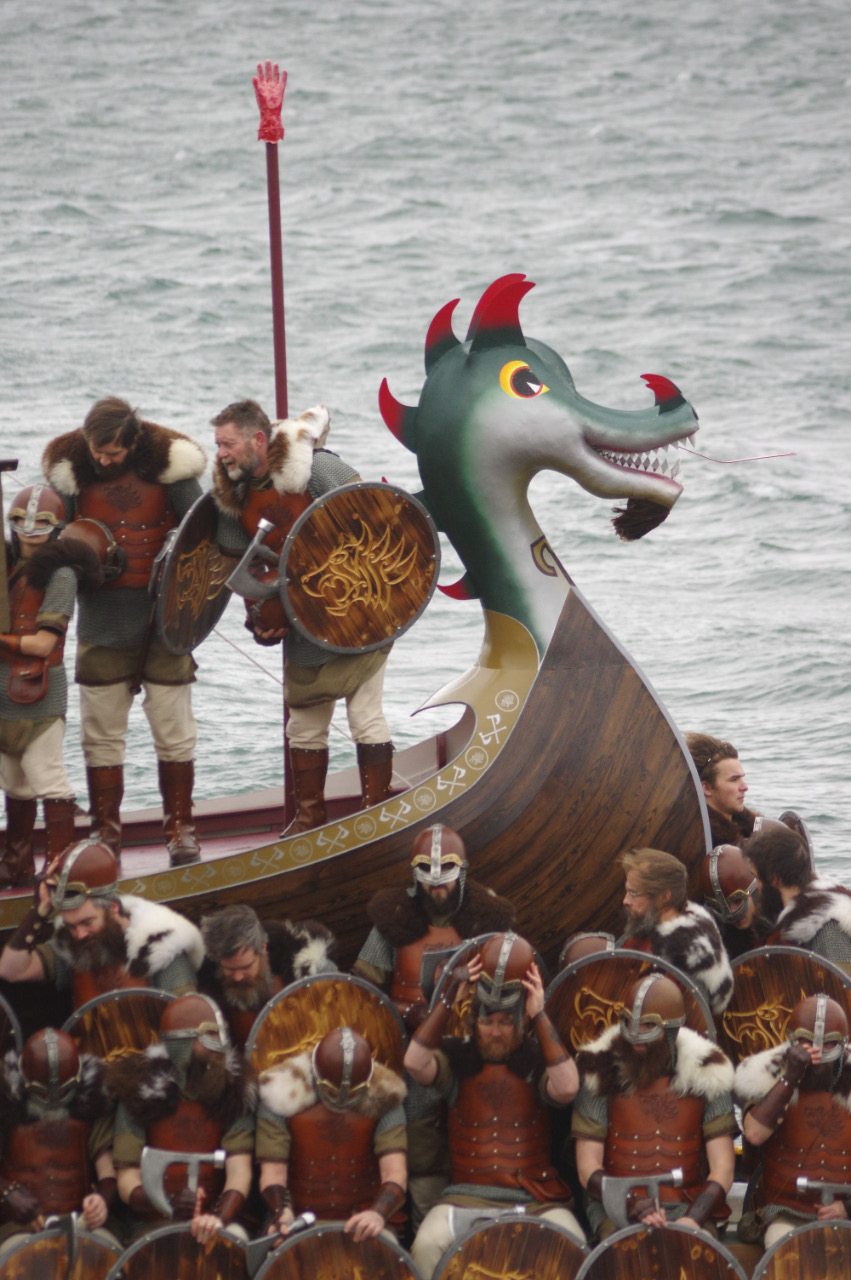
The galley is built and painted by local volunteers. Its dragon-headed shape gives the procession a focus, while its colours relate to that year’s Jarl Squad. Seeing it in daylight reveals details that torchlight can hide: painted decoration, shields and the scale of the structure. These are worth observing before the evening transforms the scene.
The fact that it will be burned does not make it disposable in the ordinary sense. Building something for a brief public life can be part of the meaning of a celebration. Look closely, but do not touch the galley or step into a working area for a photograph. A barrier may be protecting equipment, access or an official photograph rather than marking a convenient place to lean.

Torchlight through the town
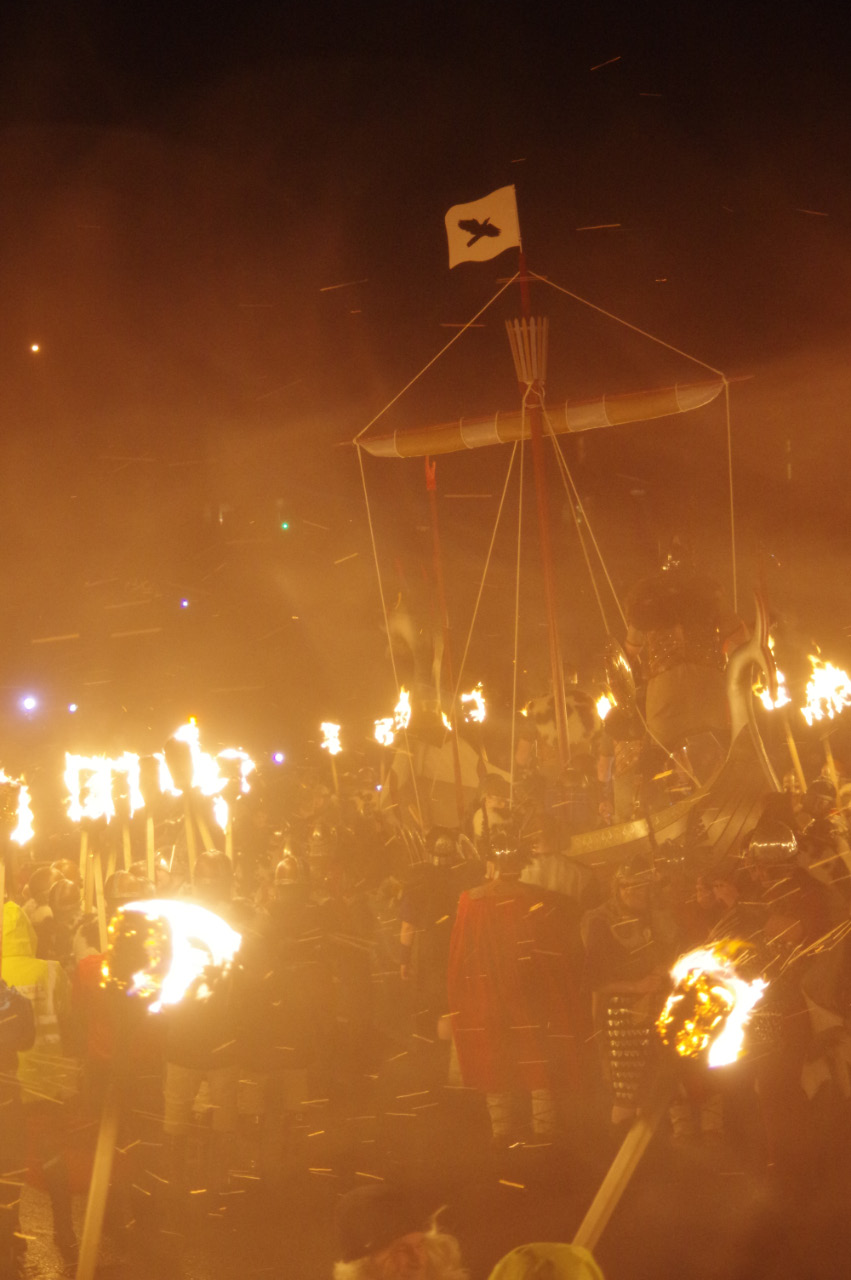
The evening brings together the separate squads and the galley. Street lighting is switched off for the procession, giving the torchlight a striking presence against Lerwick’s buildings. From a public viewing position you can appreciate the scale, movement and sound without needing to stand at the very front. A clear view is useful; a safe exit and room for the procession are essential.
Listen as well as watch. Singing and the rhythm of the march give the procession a collective character that a single flame photograph cannot convey. Keep conversations and camera movements considerate of those around you. If the crowd is too dense, choose a less pressured place rather than trying to push into a gap as the procession approaches.

The burning and what follows
The galley burning is a dramatic culmination of the outdoor procession. The organisers exclude the public and press from the burning site itself, so visitors must watch from outside the controlled area. Follow stewards and police, stay behind barriers and accept that the best-looking angle in an old photograph may not be an available spectator position today.
The burning is not the end of the festival for the squads. They continue into halls, where performances, music and dancing carry the celebration through the night. This indoor life is an important part of understanding Up Helly Aa, even if you do not attend it. A visitor can enjoy a complete public evening without assuming a right to follow participants into private venues.
Halls, hosts and legitimate access
Hall celebrations depend on volunteers and hosts as well as the visiting squads. An act may make sense through local references, shared humour or a familiar piece of music. Guests join a social occasion with its own expectations; it is not simply an after-party attached to a public spectacle. Arrive prepared to listen and participate considerately if you have a valid invitation or ticket.
Ticket arrangements vary by hall. The committee’s Town Hall page is the place to watch for its public application process, while other hosts manage their own invitations and admission. A hall being listed as open for the festival does not mean it accepts walk-ins. Verify access before planning your night, and keep your accommodation and return journey independent of a hoped-for ticket.

A living and changing Shetland tradition
Participation has changed over time. From 2023, Lerwick’s squads could be organised without gender restrictions, as the committee’s history explains. State that development plainly rather than presenting an older all-male description as the current rule. The festival’s history includes change as well as continuity, and the people maintaining it continue to decide how it moves forward.
Other Shetland communities hold their own fire festivals on different dates, with individual identities and arrangements. They should not be treated as interchangeable copies of Lerwick. Check the relevant local organiser if extending your visit. The strongest experience comes from understanding Up Helly Aa as a living community tradition, not simply a spectacular fire event: notice the craft, respect the boundaries and give the wider place your attention.
2When & Where
Plan around the confirmed 26 January 2027 date, official public programme and controlled viewing areas.

When Up Helly Aa Happens
The next Lerwick Up Helly Aa is Tuesday 26 January 2027. The committee’s current 2027 outline programme takes precedence over its general pages where timings differ. All times below are local Shetland time (GMT in January); reconfirm the programme and any changes before travelling.
Lerwick
The main celebration takes place in Lerwick, Shetland’s principal town. Plan around the town centre, waterfront, Hillhead and the controlled burning area. The evening is a moving procession, so choose a public viewing point using the official 2027 route information, not a route copied from an old travel blog.
Detailed 2027 road-closure orders, accessible viewing arrangements and temporary toilet provision were not verified as published at this review. Check committee and council updates nearer the day; a town-centre parking space is not a reliable evening transport plan.
Daytime Programme
The 2027 outline lists an 08:15 departure from Islesburgh Community Centre, 09:00 movement from Toll Clock to the British Legion, and a 09:40 departure along the Esplanade and Commercial Street, pausing at the Market Cross. Official photographs at Bressay Ferry Terminal are cordoned off. The Museum visit is listed at 15:30.
The Bill is displayed at the Market Cross from 06:00–17:00; after the morning march the galley remains at Bressay Ferry Terminal until 18:00, before moving to Hillhead. Check access on arrival. Civic receptions and visits to schools, hospitals and care settings are not open sightseeing stops.
Torchlight Procession
The official outline gives the Jarl Squad’s passage through the ranks at 19:15 and light-up/procession at 19:30, on Hillhead below the Town Hall. Assembly and torch handling are operational activities, not visitor participation. Remain in public areas and leave every stewarded route clear.
Arrive in the area well before light-up; a planning allowance of roughly 45–60 minutes can help you find your chosen position without rushing. This is a suggested buffer, not an official entry time or a guarantee of an unobstructed view.
Galley Burning
The procession finishes at the King George V playing field burning site. The public and press are not allowed inside. Watch from permitted positions outside the controlled area and follow staff instructions as crowd routes change. Do not climb walls, roofs or street furniture, and do not try to follow the galley through a closed entrance.
Hall Celebrations
After the outdoor event, squads move between halls for acts, music and dancing. The published outline places the Jarl Squad’s first evening hall visit at 21:15; that is not a public hall-opening time. Admission is by the relevant invitation or ticket, and many celebrations are private.
At review, the Town Hall ticket page still described the closed 2026 applications and advised checking later in 2026 for 2027. Do not read its £50 price or previous event hours as a confirmed 2027 offer. Follow the next published application notice and the conditions on your actual ticket.
Best Time to Arrive
Reach Shetland before festival day, with a weather buffer if possible. Stay in or near Lerwick on the main night and plan your departure with room for disruption and rest. An overnight ferry due on the festival morning or a same-day flight gives you little recovery time if the service is delayed.
A typical festival sequence
- Morning: watch a public Jarl Squad march and read the Bill.
- Daytime: see the galley, explore Lerwick and take a warm meal break.
- Afternoon: attend a confirmed public appearance and prepare waterproof layers.
- Evening: choose an authorised viewing position before assembly and light-up.
- Procession and burning: stay outside the route and controlled burning site.
- Afterward: squads move to halls; attend only with legitimate access.
- Overnight: celebrations continue, while other visitors return to their accommodation.
3Festival Advice
Book early, prepare for Shetland winter weather and arrange a realistic way home after the procession.

Book the bed before the trip
Accommodation is the first constraint to resolve. Lerwick has a limited supply, and demand rises around the festival. Book a confirmed room early, check cancellation terms and ask how you will get back after the evening. A room elsewhere in Shetland can be useful only if a realistic late-night return is arranged.
Book flights or ferry travel alongside accommodation rather than assuming either will remain available. A ferry cabin or suitable seat can make a long winter journey more comfortable. Keep a copy of every confirmation offline and monitor the operator’s service notices before setting out.
Allow for winter transport
Wind, sea conditions and operational disruption can affect island connections. Add time before the main day and avoid a tight onward commitment immediately after your planned return. Leave enough money and flexibility to cope with an extra night if necessary.
The airport bus, town services and taxis are separate parts of the plan. Check the actual festival-day and next-day bus timetable; special arrangements can replace ordinary services. Pre-book an essential taxi and confirm a pickup point outside road closures. Do not assume frequent transport will be running after the burning or through the night.
Dress for standing outside
A waterproof outer layer, warm midlayers, hat and gloves are the foundation. Add sturdy waterproof footwear with grip and leave fashion-only shoes for another occasion. Standing still feels colder than walking, especially in wind and rain. Keep a dry layer available if you can return to your accommodation.
Use a small secure bag so you do not take up unnecessary space in the crowd. Protect a phone and camera from rain, keep battery power warm and carry a power bank. A weather forecast helps with preparation, but it cannot tell you exactly how exposed a particular viewing point will feel.
Fire, barriers and crowd density
Watch from authorised public areas, never from the procession route. Do not touch torches, the galley or ceremonial equipment. Leave gaps used by stewards clear and move when asked; the safest position may change with wind, fire operations or crowd pressure.
Keep children close, agree a meeting point and identify a way to leave before the procession starts. If someone in the group is uncomfortable in a dense crowd, choose a less pressured viewing position or the daytime programme. Do not use a child’s pushchair or mobility aid to hold a gap in an operational route.
Hall access and local residents
Only enter a hall if you have the correct ticket or a genuine invitation. Ask the host about arrival, food, seating, dress and photography rules. Do not expect accommodation staff or the festival committee to find you a last-minute private invitation.
Respect doorways, gardens and residential windows while waiting outdoors. Keep noise down when returning late and take rubbish with you. The town continues to be home for people who may be working the next day, resting or choosing not to join the crowds.
Food, toilets and accessibility
Eat before the main evening and identify a warm place to take a break. Check kitchen closing times and do not count on finding a late meal after every venue has filled. Carry water, but keep your bag light enough for several hours outdoors.
Ask your accommodation about nearby toilets and check the current event notices for temporary facilities. Availability and step-free access should be confirmed directly. Lerwick includes slopes, kerbs and crowded pavements; do not assume a viewing point that looks close on a map is accessible.
If you need seated or accessible viewing, contact the relevant organiser well ahead of travel with your actual requirements. Confirm the approach, drop-off, surface, toilets and departure route before paying for an arrangement. No designated 2027 accessible viewing provision was verified at review, so this guide does not promise one.
Common Mistakes
- Arriving without confirmed accommodation.
- Assuming every hall accepts visitors or walk-ins.
- Underestimating January cold, wind, rain and darkness.
- Wearing inadequate waterproof layers or slippery footwear.
- Standing too close to flames or entering a controlled area.
- Expecting frequent late-night buses or an unbooked taxi on demand.
- Treating squads only as costume entertainment.
- Blocking the procession for a photograph.
- Assuming the celebration ends when the galley burns.
4How to Experience
Experience the public day and evening with time to appreciate Lerwick, the squads and the wider Shetland setting.
Essential Up Helly Aa Experience — the main evening
Arrive in Lerwick with accommodation and your return route already settled. Eat early, dress for a long period outside and use the published route to choose an authorised viewing position. Watch the torchlight procession, look for the galley and appreciate the whole movement through the town rather than chasing one close-up.
If your permitted position offers a view of the burning, watch from outside the cordoned site. Accept that the public route and barriers determine what you can see. Afterward, return to your accommodation or a venue where you have confirmed admission; an enjoyable evening does not depend on obtaining a hall ticket.
Full Festival Experience — a day in Lerwick
Reach town before the public morning march. Watch the Jarl Squad, read the Bill and see the galley in daylight where access is permitted. Leave the cordoned official photograph to its participants and do not follow private visits. A museum stop and a walk around the town can add context between scheduled appearances.
Build in a warm lunch, a rest and time to dry clothing before the evening. If attending a public Museum appearance, confirm its timing and access directly. Return to the procession area early enough to find your place calmly. Only add an overnight hall celebration when you have a legitimate invitation or ticket and understand the host’s conditions.
Best Shetland Experience — give the place more time
The strongest experience comes from understanding Up Helly Aa as a living community tradition, not simply a spectacular fire event. Spend additional days learning about Shetland’s history, music and contemporary life. Winter daylight is short, so plan one manageable outdoor outing at a time, follow weather advice and keep coastal walks away from exposed edges.
Explore Lerwick’s waterfront and heritage at a comfortable pace, and check opening hours before travelling to a museum or attraction. Some places and seasonal exhibitions do not run their summer schedule in January. Ask locally about a music session or other public event, with the same care for access and booking that you give the main festival.
Other Shetland fire festivals have their own dates and identities. A longer stay may allow another visit, but check that event’s organiser and transport rather than assuming a second procession will happen nearby the next night. Allow a buffer before and after your island journey so the trip is not balanced on one flight or sailing.
Watch with curiosity
Notice how the Jarl Squad differs from the other guizer squads, how a song brings a crowd together and how people respond to a familiar act. These details give the spectacle its meaning. A programme can help explain characters and the sequence, while a conversation may reveal a year of preparation behind a few minutes in view.
Visitors watch the public celebrations; joining the procession is not an activity available simply by wearing a costume. The committee publishes residence requirements for participation. Respect the distinction, keep your camera within spectator space and let local people lead their event.
5Photo Guide
Photograph torchlight, craft and community respectfully from authorised public positions.
Best Subjects
Build a story across the day: the Guizer Jarl and Jarl Squad, painted shields, the galley in daylight, wider guizer squads, torchbearers, Lerwick streets and the atmosphere of people waiting together. Include musicians and town context as well as flames. Clearly label archival photographs; an old squad’s outfit does not establish the next Jarl Squad’s design.
Best Light
Daytime appearances make details easier to see and often give more flexibility than the main procession. January daylight is limited; use it for the galley, streets and permitted portraits. At night, the bright torches sit against deep shadows, so expect to choose between retaining flame detail and recording every face clearly. Protect equipment before rain arrives.
Best Positions
Use the official route and stand in an authorised spectator area with room to leave. A wide view down a permitted street can be more effective than a tight front-row position. Remain outside all barriers and the burning site. Do not assume a photographer visible in an archive image was standing in a place open to ordinary spectators.
Torchlight Procession Photography
For moving people, begin around 1/250–1/500 second with a wide aperture and raise ISO as needed; these are starting points, not settings that fit every camera. A fast prime lens can help, while a wide-angle view records the relationship between torchlight, town and crowd. A telephoto lens can isolate a detail from your existing safe position.
Use short bursts rather than holding the shutter continuously, and keep an eye on people around you between frames. Do not step into the route to remove a head or barrier from the composition. Avoid intrusive flash and any lighting that distracts participants.
Galley Burning Photography
Expose with the flames in mind. Reduce exposure if highlights are clipping, take a test frame and check the result as the brightness changes. Silhouettes can tell the story without trying to lift every shadow. A wide composition can show the scale more clearly than a close crop of fire alone.
Stay at the public viewing distance set by staff. Do not chase sparks, climb structures or enter the site after the main flames subside. Smoke and wind may obscure a view; accept that limitation rather than moving into a controlled area.
Low-Light & Fire Photography
High ISO is often preferable to a blurred moving subject. If your camera allows it, shoot RAW for more flexibility with white balance and shadow detail later. Avoid a tripod where it obstructs a busy pavement; stabilise the camera with your stance and use a shutter speed suited to the subject.
Bring a rain cover and a dry cloth, keep spare batteries warm and avoid changing lenses in driving rain. Strap the camera securely and keep bags away from the moving crowd. A small kit that you can manage with gloves is more practical than equipment you cannot protect.
Portrait & Detail Photography
Ask before close portraits when there is time, and accept a refusal. Do not stop the Jarl Squad during a timed movement or enter a cordoned official photograph. Shield patterns, stitching, instruments and the painted galley can convey craft without requiring intrusive access. Seek a parent or guardian’s permission for a close portrait of a child.
Phone Photography
Use the main lens or a genuine optical zoom setting and avoid heavy digital magnification. Tap to focus and lower exposure slightly to preserve the brightest torches. For moving people, a short burst may work better than a long night-mode exposure; use night mode only when the subject and your hands can remain still.
Keep the phone dry and warm, carry a power bank and save enough battery for transport and contact details. A brief video can record singing and the movement of the procession, provided you hold the phone within your own space and do not block someone else’s view.
What Not to Do
- Do not enter the procession route or cross a barrier.
- Do not go into the galley-burning site, including after the burning.
- Do not climb walls, roofs, lamp posts or other structures.
- Do not touch torches, the galley or ceremonial equipment.
- Do not fly a drone unless the relevant authorities and organisers have explicitly permitted it.
- Do not enter a private hall or photograph its guests without legitimate access and the host’s permission.
Practical Information
Prepare for winter weather, limited accommodation and a late return after the procession.
Best Time to Arrive
Reach Shetland before festival day, with a weather buffer and a confirmed overnight stay.
How to Get There

Fly to Sumburgh or take the overnight ferry to Lerwick, then check local winter connections.
What to Bring

Pack waterproof outerwear, warm layers, gloves and sturdy footwear for a long winter evening.
What to Expect
Expect dark, cold streets, torchlight and strong community participation, followed by hall celebrations.
Arrive before the main day
Avoid relying on a festival-day flight or ferry arrival for your only chance to attend. Build in at least a day beforehand where possible, and more flexibility if the trip can support it. This is a planning buffer, not a guarantee against winter disruption. Monitor the operator’s latest notices.
On the day and afterward
Be in Lerwick early enough for your chosen public appearance and take time to locate evening viewing areas in daylight. Before the main procession, allow time to eat, use a toilet and put on warm waterproof layers. Stay overnight after the event and leave room to rest before travelling.
If you have a hall invitation or ticket, follow its arrival instructions and arrange your return in advance. Do not schedule a tight departure immediately after an all-night celebration.
By air to Sumburgh
Loganair currently lists Sumburgh services from Scottish gateways including Aberdeen, Edinburgh, Glasgow, Inverness, Dundee and Kirkwall. Check the dynamic timetable for your exact January dates; a listed route does not promise a daily winter flight.
Sumburgh Airport is nearly 25 miles south of Lerwick. Allow roughly 40–50 minutes by road in ordinary conditions as a planning estimate, then add weather and pickup time. Service 6 links the airport and Lerwick; check the current ZetTrans timetable, including any festival or next-day changes. A bus journey can be around an hour or more depending on stops. Pre-book an essential taxi.
By ferry to Lerwick
NorthLink operates the overnight route from Aberdeen, with Kirkwall calls on selected sailings. Its published January–March 2027 northbound pattern is 19:00 direct from Aberdeen on Monday, Tuesday, Wednesday and Friday; 17:00 via Kirkwall on Thursday, Saturday and Sunday, arriving Lerwick at 07:30. A maintenance timetable applies 10–23 January, so check your specific travel dates.
A direct overnight crossing is scheduled at about 12½ hours; a Kirkwall routing takes longer from Aberdeen. Check booking, cabin availability, check-in and live service updates directly. Ferry timetables are subject to weather and operational changes.
In and around Lerwick
Walking can be the simplest way between central points, but expect slopes, wet surfaces, crowds and closures. Use local buses where the timetable fits and arrange taxis early. Do not assume overnight public transport after the procession. Agree a pickup point outside the closure area and a backup plan if the vehicle is delayed.
A practical winter festival bag
- Waterproof outerwear, warm layers, a hat and gloves.
- Sturdy waterproof footwear with grip.
- A charged phone, power bank and offline booking/transport details.
- A camera if wanted, with a secure strap and rain protection.
- A small secure bag, water and only the valuables you need.
- A dry cloth and a spare warm layer if you have space.
Keep it manageable
Choose a compact bag that will not block the pavement or catch people in the crowd. Keep batteries warm, protect electronics from rain and leave your hands free when moving. Follow any current event or hall bag restrictions.
Outdoors in January
Expect winter cold, wind and possible rain, with long periods standing outside. Streets can become crowded as the procession approaches. Torchlight and flames are controlled parts of the event; spectators remain outside the route and burning site.
People and atmosphere
The Jarl Squad’s Norse-inspired dress is one element of a broader guizing tradition. Look for other squad characters, musicians and community connections. Singing and shared anticipation matter as much as the fire.
The outdoor burning is followed by hall performances and late-night celebrations for those with legitimate access. Other visitors return to their accommodation; there is no automatic admission to private parties.
Plan the practical limits
Accommodation is limited and winter connections can be disrupted. Confirm where you will sleep, how you will return and what you will do if travel changes. A thoughtful plan gives you more space to enjoy the celebration.
Photo Gallery
Archival Lerwick scenes: guizers, Jarl Squad, galleys, music, community and torchlight by day and night. Past images do not establish this year’s outfits or viewing access.




Current information and sources — reviewed 5 November 2026
The committee confirms 26 January 2027 and publishes an outline programme. Use that year-specific page where it differs from generic daytime guidance. At review, the Town Hall application page still described the closed 2026 process; 2027 hall terms, detailed road closures, accessible viewing and special local transport must be reconfirmed. Do not assume an archived hall list grants admission or a route photograph permits entry.
Official 2027 date, outline and route · Festival history and participation · Guizer Jarl and Jarl Squad · The galley · Procession · Day programme and burning-site restriction · Hall access · Town Hall applications · Visitor participation guidance · Promote Shetland · Wider fire festivals · NorthLink 2027 timetable · Loganair routes · Flight schedules · Sumburgh ground transport · ZetTrans buses
Photo credits and licences
Banner supplied by the site owner. Gallery photographs are archival and may be responsively cropped. Original files, authors and licences are linked below; CC BY-SA cropped adaptations retain the applicable share-alike licence.
Lerwick Up Helly Aa Guizers in Procession.jpg — Griceylipper · CC BY 4.0. Responsive cropping.
Jarl’s Squad Lerwick 2019 (01).jpg — Malvara · CC BY-SA 4.0. Responsive cropping.
The Jarl Squad and the galley — Up Helly Aa — geograph.org.uk — 5274623.jpg — Stephen McKay · CC BY-SA 2.0. Responsive cropping.
The Jarl Squad and the galley — Up Helly Aa — geograph.org.uk — 5274633.jpg — Stephen McKay · CC BY-SA 2.0. Responsive cropping.
Pipers — Up Helly Aa — geograph.org.uk — 5274176.jpg — Stephen McKay · CC BY-SA 2.0. Responsive cropping.
The Jarl Squad — Up Helly Aa — geograph.org.uk — 5274278.jpg — Stephen McKay · CC BY-SA 2.0. Responsive cropping.
The galley — Up Helly Aa — geograph.org.uk — 5274187.jpg — Stephen McKay · CC BY-SA 2.0. Responsive cropping.
Alexandra Wharf — Up Helly Aa — geograph.org.uk — 5274620.jpg — Stephen McKay · CC BY-SA 2.0. Responsive cropping.
Junior Jarl Squad — Up Helly Aa — geograph.org.uk — 5274691.jpg — Stephen McKay · CC BY-SA 2.0. Responsive cropping.
Junior galley — Up Helly Aa — geograph.org.uk — 5274700.jpg — Stephen McKay · CC BY-SA 2.0. Responsive cropping.
The Jarl Squad — Up Helly Aa — geograph.org.uk — 5273661.jpg — Stephen McKay · CC BY-SA 2.0. Responsive cropping.
The galley — Up Helly Aa — geograph.org.uk — 5273617.jpg — Stephen McKay · CC BY-SA 2.0. Responsive cropping.
The galley — Up Helly Aa — geograph.org.uk — 5274640.jpg — Stephen McKay · CC BY-SA 2.0. Responsive cropping.
Torchlight procession — Up Helly Aa — geograph.org.uk — 5274845.jpg — Stephen McKay · CC BY-SA 2.0. Responsive cropping.
Torchlight procession — Up Helly Aa — geograph.org.uk — 5274852.jpg — Stephen McKay · CC BY-SA 2.0. Responsive cropping.
Torchlight procession — Up Helly Aa — geograph.org.uk — 5274871.jpg — Stephen McKay · CC BY-SA 2.0. Responsive cropping.
Up Helly Aa, circle around the galley — Lerwick, Shetland, Scotland.jpg — Christian Cooijmans · CC BY-SA 4.0. Responsive cropping.
Up Helly Aa (5393117693).jpg — Vicky Brock from Tallinn, UK · CC BY-SA 2.0. Responsive cropping.
Up Helly Aa (5393225551).jpg — Vicky Brock from Tallinn, UK · CC BY-SA 2.0. Responsive cropping.
Up Helly Aa (5393828404).jpg — Vicky Brock from Tallinn, UK · CC BY-SA 2.0. Responsive cropping.


